In Minneapolis, in the week of June 14, 1931, the president of the National Conference of Social Work gave the presidential address and told the profession that it did not know whether its work did any good. He was Richard Clarke Cabot, sixty-three, a Boston physician who held a chair of clinical medicine and a chair of social ethics at Harvard, and he had brought numbers. The Massachusetts Reformatory at Concord, “probably one of the best institutions of its kind in the country,” had been believed to reform 80 per cent of the men sent to it, until Sheldon and Eleanor Glueck traced five hundred of them for five years after release and found 80 per cent of failure. A study of “one of the best known private case work agencies in Boston,” soon to be published, showed 88 per cent of failures in a thousand unselected cases. Cabot called the methods of the day a pea-shooter fired at a granite fortress, and said he was not sorry: “Human society would soon be in a hopeless mess if human character were of such a flabby texture that it could be easily molded by whomever thinks he knows how.”
Then, under the ninth of his twelve headings, he answered the people who said no agency could ever be judged, because so many other things act on a client’s life. “Pending the much-to-be-desired epoch when we shall control our results by comparison with a parallel series of cases in which we did nothing, we must admit that we may not be responsible either for our successes or our failures.”
Four years later he began to build the parallel series himself: several hundred boys from the poorer streets of Cambridge and Somerville, Massachusetts, sorted into pairs so alike that his staff called them diagnostic twins, one of each pair chosen by a coin for years of friendship, tutoring, doctors, summer camps and help for the family, the other left alone and watched. He died three and a half weeks before the first day of treatment. The counselling ran from 1939 to 1945. In 1945, when it ended, the counsellors named the thirty-eight boys they believed the programme had helped most. It would be more than thirty years before anyone compared those thirty-eight with their twins, and when Joan McCord did, four had done better than the boy the coin had left alone, twenty-two had done about the same, and twelve had done worse.
Who ran it
Richard Cabot was born in Brookline, Massachusetts, on May 21, 1868, into one of the merchant families of Boston; his father, James Elliot Cabot, was a philosopher and the biographer of Emerson. He took his Harvard degree in 1889 and his medical degree in 1892, and went to work in the outpatient department of the Massachusetts General Hospital, where the poor of Boston came, rather than in its laboratories. He made his medical name with the blood, with a guide to its clinical examination in 1896, and with the teaching conference in which a physician diagnoses a case aloud before the pathologist reveals what the post-mortem found. In 1905 he hired a social worker for the outpatient clinic, on the theory that a doctor who did not know how a patient lived could not treat him, and when the hospital would not pay for her he paid her himself, and the twelve who followed her, until the hospital took over their wages in 1919. In 1919 Harvard gave him its chair of social ethics, and from then on he was a physician who taught philosophy and a philosopher who read case records. In 1931 the social workers made him their president.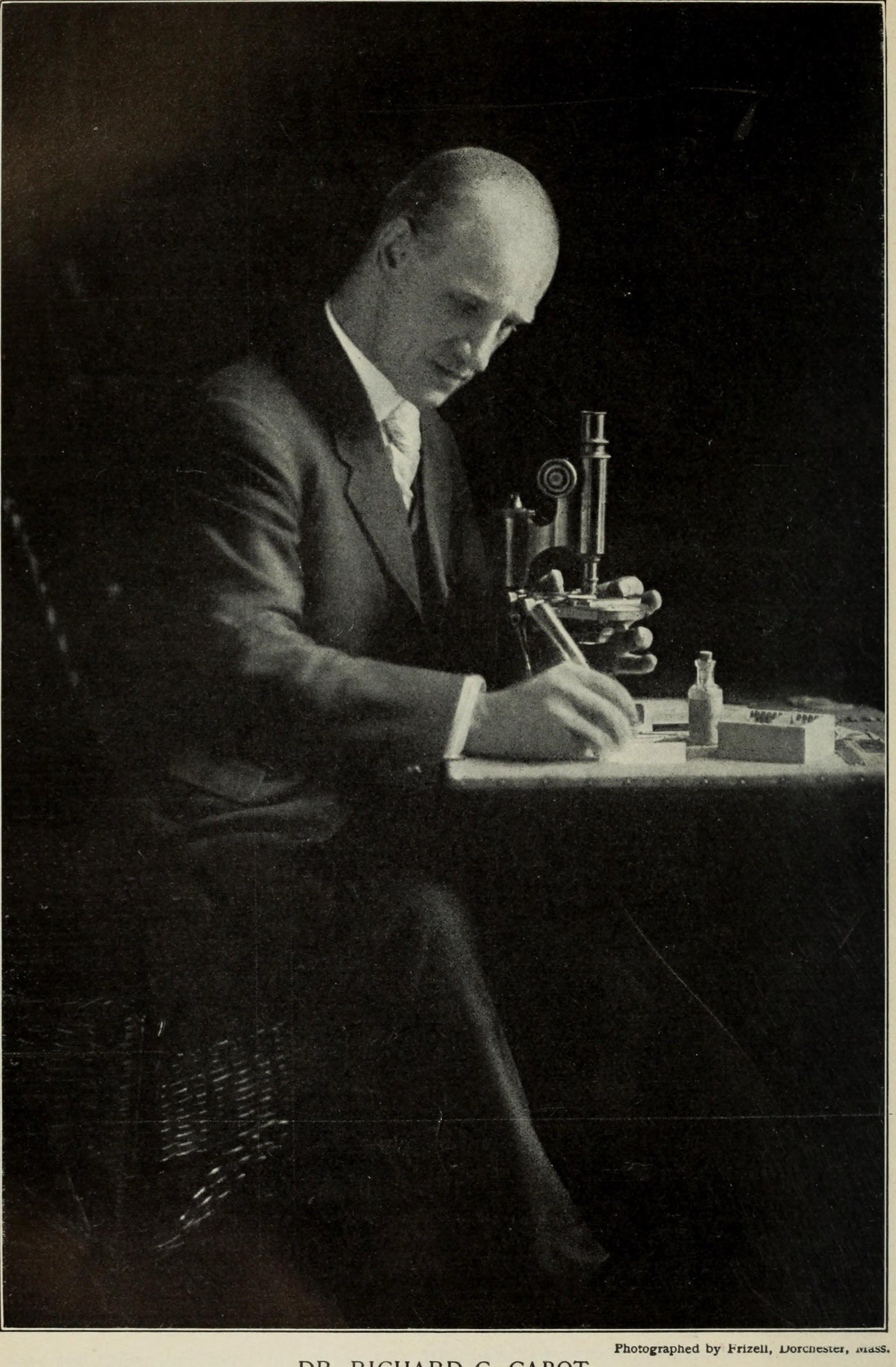
His wife, Ella Lyman Cabot, a writer on ethics whom he had married in 1894, died in 1934. In 1935 he incorporated a charity in her name, the Ella Lyman Cabot Foundation, for one purpose: to pay for an experiment on boys who seemed likely to become delinquent, and to pay for it long enough to find out. In the same year he appointed a selection committee of three practitioners of juvenile and criminal justice, and a staff began to ask the schools of Cambridge and Somerville for names. He directed the study himself until his death in Cambridge on May 7, 1939, at seventy.
The people who ran it after him were a psychologist of his own surname, P. S. deQ. Cabot, who had run the pre-selection of the boys and was the study’s director in 1940; Edwin Powers, on the research staff from 1937 and director from 1941 to 1951, who wrote the manual the counsellors worked from; and Helen Witmer, who was brought in to evaluate what the counsellors had done. Gordon Allport, the Harvard psychologist, sat on the study’s advisory committee, alongside Henry Murray and, from Geneva, Jean Piaget, and he was president of the board of the Cabot Foundation when the results came in. The committee on treatment included William Healy and Augusta Bronner of the Judge Baker Guidance Center in Boston, whose review of four thousand delinquents had taught Cabot where delinquency was made.
The person who read the instrument was Joan McCord. She was born Joan Fish in Manhattan on August 4, 1930, took a degree in philosophy at Stanford in 1952, and came to Harvard, where in 1956 she and her husband, the sociologist William McCord, began the second follow-up of the Cambridge-Somerville boys, reading the counsellors’ case records and tracing the men through the Massachusetts courts. Their book, Origins of Crime, came out in 1959. She went back to Stanford for a doctorate in sociology, finished in 1968, taught at Drexel and then, from 1987, at Temple University in Philadelphia, and in 1975 she took up the study again with a grant from the National Institute of Mental Health and the help of the Massachusetts Department of Probation. She directed it until her death in 2004.
What they were trying to find out
The study had two objectives, and its staff were careful to write them down. Powers’s manuscript, as a Boston University student who worked in the files in 1947 summarised it, gave the first as “the prevention of delinquency by the employment of wise and friendly ‘counsellors’ who would deal with a selected group of boys over a long period of time,” and the second as “the measurement of the effectiveness of this work” by comparing the boys treated “with other boys in a carefully constructed control group which would be substantially similar to the treatment group but which would receive no help or guidance from the Study during its existence.” The director put it in one sentence in 1940: “Thus treatment and research objectives are closely intertwined.”
The hypothesis behind the first objective was Cabot’s, and Allport stated it in his foreword to the 1951 report, in words McCord later quoted: that even a rebellious boy from a bad home “may conceivably be steered away from a delinquent career and toward useful citizenship if a devoted individual outside his own family gives him consistent emotional support, friendship, and timely guidance.” The study’s own 1940 statement of philosophy said what the counsellor was for. “By a friendly interest in a boy’s problems, each counsellor hopes to supplement but not replace what would normally be a satisfactory parent-child relationship.” The family was “an essentially fundamental unit of society,” and only rarely would a boy be moved to a foster home. The programme was, in its own words, “one of character development.”
That was the claim to be tested. The second claim was Cabot’s 1931 address made into a building: that a social treatment could be judged at all, if a parallel series of cases was built before the treatment began and read afterwards by criteria stated in advance. Cabot had spent a page of that address on what he called the time element, the habit of calling a case a success a few months after it closed. “It is always hard to find ‘successful’ cases that will stay successful until the report is printed!” He wanted the counselling to run for ten years.
What they built
The building took four years, and most of it was selection. Early in the 1935 school year the teachers of the public and parochial schools of the two cities were asked for the names of boys who “needed the kind of help the agency was prepared to offer,” and, to keep the help from being a label, for the names of “average” boys of the same ages and grades. Social agencies, settlement houses and the police sent names too. The 1951 report counted 1,953 boys screened; the director’s count in 1940 was 1,866 referred. Cabot’s own list of what the committee should look for, in a letter of June 3, 1935, ran: “persistent truancy, persistent breaking of the rules, sex difficulties, petty pilfering and stealing, failing to return home after school, and, among the kindergartners, temper tantrums.”
Every boy still on the list was examined by the study’s physician and tested by its psychologists; a woman home visitor interviewed his mother; his teacher filled out a rating scale and a trait card listing ninety-three unfavourable characteristics; the courts and every agency that knew the family were consulted. In July 1937 the staff took forty-seven of the oldest boys on overnight camping trips in groups of five to ten, to find out what the paper could not tell them. Boys who had turned twelve, or moved away, or could not be found were dropped; 538 were dropped because their families did not fit the study’s criteria, such as low income. What remained went to the selection committee, a psychiatrist and two social workers chosen from thirty-seven candidates, who met twenty-five times between October 1937 and January 1939, each reading every folder on his own and then conferring. They rated each boy on an eleven-point scale, from minus five, the greatest likelihood of a delinquent career, to plus five, and, since they did not know which group a boy would fall into, they were told to predict as if he would get no help. They passed 782 boys: 360 “difficult,” 334 “average” and 88 “zero,” about whom they could not agree.
Then the matching committee, three members of staff, went looking for what the director’s 1940 article called “diagnostic twins.” Each folder was coded onto a data sheet of about 160 items, the 1951 report says 142 rated on an eleven-point scale, under general and medical information, developmental and personality data, educational and mental status, personality ratings and the committee’s disposition, and the pairing was done by “a searching clinical review” of the sheets: age, stock, the parents’ birthplaces, religion, school and grade, health, intelligence, attainment, adjustment, the judges’ verdict, the home, the father’s occupation, the neighbourhood. A report was written for every pair with the reasons for the match. Six hundred and fifty boys were matched in this way, 325 pairs; the surplus, 132 boys, was set aside.
The last step was the one Cabot added. “The next question was to determine whether any given boy should fall into the treatment or the control group,” Powers and Witmer wrote in 1951. “It was evident that an arbitrary decision might give rise to a constant error. The proper method of determining this question was, of course, by chance. Accordingly, a coin was flipped and the cases fell into the treatment or comparison groups in accordance with its fall.” Matching alone, they explained, could not be trusted: “even if the measures used in the matching were not perfectly reliable, chance would tend to preserve, in groups as large as 325 each, an even balance of important factors.” There were two exceptions, which McCord recorded later. Eight boys were matched after their treatment had begun, and brothers went to whichever group the first brother had drawn, which put twenty-one boys in the treatment group and nineteen in the control group by kinship rather than by coin. As far as the study’s historians can find, nobody in the social sciences had tossed a coin after matching in pairs before.
The assignment of boys to counsellors began on November 12, 1937 and finished on May 13, 1939, and “June 1, 1939 was arbitrarily set as the date when treatment began after the last case had been assigned.” Cabot had been dead for twenty-five days. In the first year, by the director’s tables, the counsellors made 2,353 interviews with families and 2,717 with boys, and drew on eighty-eight cooperating agencies in greater Boston for tests, camps, clothing, jobs, dentists and foster homes. A full-time counsellor carried about thirty-four boys and was expected to see each of them and his family about twice a month, more often when it seemed necessary. Over the life of the study nineteen counsellors were employed, fifteen men and four women, eight of them trained social workers; the qualification the report gives for the rest was a “warm, outgoing” disposition, and Powers wrote in 1949 that “each counselor was left largely to his own resources” in deciding what a boy needed. They were forbidden to go to court with a boy, and forbidden to have anything to do with the boys in the other group, whose records were kept by a supervisor of the controls who collected what the schools, the probation officers, the churches and the camp directors knew.
Then the war did what the budget had not. In 1942 petrol was rationed, young counsellors went into the services, and the study was cut, by the counsellors’ judgment of which families were cooperating, how much had already gone into each boy and how far some had moved, to 253 pairs, 506 boys; when a treated boy was dropped his twin was dropped with him. The 253 pairs were compared again and found alike on age, intelligence, the committee’s prediction, health, the teachers’ ratings of adjustment, aggressiveness and acceptance of authority, and every rating of the home. The counselling ended on December 31, 1945, four years short of Cabot’s ten. The 253 treated boys had been in the programme for an average of five and a half years. More than half had been tutored, more than a hundred had seen a doctor or a psychiatrist through the study, 125 had been sent to summer camp, and most had swum, gone to ball games and built things in the project’s woodwork shop with a man who came to the house. The boys in the control group had been given a medical examination, a few tests, and nothing else.
Fifty-seven comparisons
The first reading was Witmer’s, in 1948. The counsellors had rated their boys at the end, and many who had entered the programme as likely delinquents had made what she called fairly good adjustments; judged by improvement on the committee’s prediction, the programme had worked. So the staff found 148 of the control boys and interviewed them, their families and their school principals, and Witmer rated each control boy’s adjustment beside his twin’s. Almost as many of the untreated boys had done better than predicted as the treated. In the same year the Massachusetts Board of Probation ran the names: 96 treated boys had been to court against 92 controls, for 264 offences against 218. Powers and Witmer published the whole thing in 1951, 649 pages, with Allport’s foreword. Allport asked for patience. The programme, he thought, might have prepared the boys to profit from experience, so that the benefit would show as they grew up.
In 1956 the McCords traced the official records again and found the control boys had committed, if anything, a few more crimes, a difference that was not reliable. Origins of Crime in 1959 used the case records, which ran to several hundred pages a boy, to study where crime came from as much as whether the counselling had prevented it. The men were by then in their twenties.
The third reading began in 1975, when they were about forty-five. McCord and her assistants took the names of all 506 men through the records of the Massachusetts Board of Probation, the Department of Mental Health, the Division of Alcoholism and the registry of vital statistics, then through more than a hundred alcoholism treatment centres and the criminal justice departments of other states, and then through telephone books, city directories, motor-vehicle registrations, marriage and death records and, she wrote, “lucky hunches.” By 1976 they had found 480 of the men, 95 per cent; 48 were dead and 340 were still living in Massachusetts. By January 1979 they had found 98 per cent. Questionnaires went to 208 men of the treatment group and 202 of the control group, asking about marriage, children, work, drink, health and attitudes, and 113 and 122 came back. The men were later asked for interviews, and 343 gave one or answered the questionnaire.
She counted crimes first. As juveniles, 136 treated boys and 140 controls had no record; 72 and 67 had official records, 45 and 46 unofficial ones kept by the Crime Prevention Bureau. As adults, exactly 168 of each group had been convicted of something; 49 of the treated men and 42 of the controls had committed serious crimes against property or persons, 29 and 25 after the age of twenty-five. The number of serious crimes, the age at the first crime, the age at the first serious crime, the age after which no serious crime was committed: none of them differed. Holding the committee’s prediction scores constant made no difference either. Of fifteen comparisons of criminal behaviour, one was significant, and it ran the wrong way: among men with any criminal record, 78 per cent of the treated had committed at least two crimes, against 67 per cent of the controls.
Then health. Seven per cent of one group and 8 per cent of the other had been treated for alcoholism in a clinic. But on the questionnaire, which hid four questions about drinking among questions about smoking, 17 per cent of the treated men and 7 per cent of the controls answered like alcoholics. Twenty-one men of each group had been in a mental hospital for something other than drink; the diagnoses of the treated men were the serious ones, schizophrenia or manic-depressive illness, in 71 per cent of cases, and the controls’ were mostly the lighter ones. Twenty-four men of each group were known to be dead, of causes that did not differ, but the treated men had died younger, at an average age of thirty-two against thirty-eight. The treated men more often reported at least one of nine stress-related diseases, 36 per cent against 24, and twice as often high blood pressure or heart trouble, 21 per cent against 11. Of fifteen comparisons of health, four favoured the control group, from three different sources of record.
Then work and family. The two groups had married at the same ages and had the same number of children. The same share were unskilled. But 43 per cent of the controls and 29 per cent of the treated men were in white-collar or professional work; the controls’ jobs ranked higher on the national prestige scale; and among the blue-collar men, 80 per cent of the treated and 95 per cent of the controls called their work satisfying. Two of thirteen comparisons favoured the controls. Fourteen comparisons of beliefs, of satisfaction with life, of political views, of authoritarianism on a seven-item scale, of the best period of one’s life, found nothing.
McCord did the arithmetic in the paper. Seven of fifty-seven comparisons were reliably different, which chance would produce less than 2 per cent of the time, and all seven favoured the group that had been left alone, which chance would produce less than once in ten thousand. “The objective evidence presents a disturbing picture,” she wrote. The programme “seems not only to have failed to prevent its clients from committing crimes” but “to have produced negative side effects.”
She presented a first version to a meeting of child psychiatric services in San Francisco in November 1976, and American Psychologist printed it in March 1978 under the title “A Thirty-Year Follow-up of Treatment Effects.” It was published, she said later, “only on the condition that a critical article would be coupled with its publication.” It was six pages long.
The thirty-eight boys came out of the same files. In 1945 the counsellors had picked out the boys they believed had got the most from the programme. McCord set each beside his twin. Twenty-two of the pairs could not be told apart by the records. In four the treated man had done better. In twelve he had done worse.
What it looked like from inside
The questionnaire had one question for the treated men only: “In what ways (if any) was the Cambridge-Somerville project helpful to you?” Eleven men left it blank. Thirteen could not remember the project. Thirteen said it had not helped, and several of those added that they remembered their counsellors fondly. Two thirds of the men said it had. They wrote that it had kept them off the streets, taught them to get along with others, given them guidance. The forms, McCord reported, were “sprinkled with such comments as ‘helped me to have faith and trust in other people’; ‘I was put on the right road’; ‘helped prepare me for manhood’; ‘to overcome my prejudices’; ‘provided an initial grasp of our complex society outside of the ghetto’; and ‘better insight on life in general.’” Some gave the programme credit for their whole lives: “I probably would be in jail”; “My life would have gone the other way”; “I think I would have ended up in a life of crime.” More than twenty asked for their counsellors’ addresses, thirty years on, meaning to write to them.
“Were the Youth Study program to be assessed by the subjective judgment of its value as perceived by those who received its services,” McCord wrote, “it would rate high marks.” The counsellors, by the same evidence, had done what Cabot asked. “There seems to be little doubt that many of the men developed emotional ties to their counselors.” The programme had succeeded, she wrote, in its short-term goal of making friends between social workers and teenage boys. It was the long-term goal that the records refused.
From the counsellors’ side the records are the case files, dictated after every visit and every telephone call, several hundred pages for most boys and fewer than twenty-five for the families that would not let them in. The programme’s own accounts of them describe men calling at the house twice a month for five years, taking a boy swimming, finding the money for camp, helping a family through illness and unemployment, and writing to a school. The weekly conferences at headquarters, McCord noted in 2003, made sure the counsellors were doing what they were trained to do. Nothing in the files reads as harm, and nothing in the men’s memory of it does either. The scars, she wrote in 1981, “were not those of resentment.”
From McCord’s side it looked like this. “When results of the Cambridge-Somerville study were first published,” she wrote in 2003, “I received threatening phone calls and notes. When I gave talks about these results, in many audiences, people shouted ugly names at me.” She had found that the kindest programme anyone had built, designed and funded by a man who paid social workers’ wages out of his own pocket, had hurt the boys it was kind to, and she had found it with his own instrument.
What happened
The 1978 paper had seven differences and no explanation. McCord offered four possibilities in its last paragraphs. Counsellors with middle-class values might have set up conflicts in boys who had to go on living in a working-class street. The agency might have bred dependence, which turned to resentment when the agency closed. The programme might have raised expectations that life then failed to meet. Or boys given the services of a welfare project might have come to see themselves as needing one. She ended with a recommendation that reads like Cabot: new programmes should be built, “through the use of pilot projects with mandatory evaluations.”
By 1981 she had the interviews and a harder measure. A man’s outcome was counted undesirable if, and only if, he had been convicted of a crime on the FBI’s index of serious crimes, or had died before thirty-five, or had been diagnosed as alcoholic, schizophrenic or manic-depressive. By that count 105 men of the treatment group, 42 per cent, had undesirable outcomes, against 81 of the control group, 32 per cent. In 150 of the 253 pairs the twins had come out alike. In the 103 pairs that differed, the man the coin had chosen for help was the one who had gone wrong in 63, and the man it had left alone in 39.
Then she looked for the part of the programme that had worked, and found instead that the harm had a dose. She sorted the pairs by how the treated boy had been treated. Boys whose counsellors came at least every other week for six months or more did worse than their twins in 19 pairs and better in 5. Boys in the programme for six years or more did worse in 34 pairs and better in 10. Boys with three or more counsellors did worse in 27 and better in 10; boys whose counsellors had concentrated on their personal problems, in 28 and 8; on their family’s problems, in 28 and 9. No category of treatment, early or late, close or distant, by men or by women, academic or medical, produced a set of pairs in which the treated boy did better. “Analyses of effects from treatment differences point to the conclusion that ‘more’ was ‘worse.’”
She then tested her own four explanations against the interviews, and discarded three. The treated men were not more ambitious than the controls, nor more dependent, nor more inclined to think of themselves as ill. The fourth held. They had married at the same age, 24.4 years in both groups, but more of the treated men had been separated, divorced or remarried; when coders read the interviews for warmth towards the wife, 47 per cent of the treated men showed it against 65 per cent of the controls; with occupation held constant they were less satisfied with their work; and when the interviewer closed by asking how to find them in ten years’ time, fewer of them expected to be there. “The Cambridge-Somerville Youth Study seems to have raised the expectations of its clients without also providing the means for increasing satisfactions.”
Two questions in the 1981 paper are the ones this journal exists for. “Could the adverse impact of the program have been detected at an earlier date? Could it have been detected in the absence of a control group?” To the first she plotted undesirable outcomes against age. The two groups’ curves rose together and the treated group’s rose faster, and the difference between them became statistically reliable by the age of thirty-five, which is to say in the middle of the 1960s, about twenty years after the counsellors left. To the second: “Had there been no control group, evaluation of the program might have led to radically different conclusions. Client evaluation seems to have been favorable.” Two thirds of the men had said it helped. “The subjective reports served as testimonials for the project.”
The question that remained was mechanism, and it took her until the 1990s to find a candidate. By then work on group programmes for troubled adolescents, at the Oregon Social Learning Center and elsewhere, was turning up a pattern that she said she had resisted: that putting high-risk boys together makes them worse, because they teach one another. The Cambridge-Somerville files could test it, because the counsellors had sent 125 of the 253 treated boys to summer camp, some of them several times, and had written down which. Among the 128 boys never sent to camp, 25 did better than their twins and 28 worse. Among the 59 sent once, 12 better and 16 worse. Among the 41 sent twice, 2 better and 12 worse. Among the 25 sent three times or more, none better and 8 worse. She put it to a child development meeting in Washington in April 1997: of the boys sent to camp at least twice, “2 turned out better than their matched mate and 20 turned out worse,” an adverse ratio of ten. In a discriminant analysis, camp accounted for more of the harm than anything else the counsellors had done. “I strongly suspect that the boys from the Youth Study tended to bond together, encouraging one another’s deviant values.” She added the caution herself, and her critics repeated it: the counsellors had chosen which boys to send, so the camp boys were not a random sample of the treated, and what looked like a cause might be a selection.
There was one more test, and it is the one that makes the rest hold. Sixty of the treated boys came from families the counsellors recorded as uncooperative, or whose files were under twenty-five pages. Among those sixty, 12 did better than their twins and 12 worse: no effect. Among the 193 whose families had let the programme in, 27 did better and 52 worse. The harm had gone where the treatment went.
She summed it up in 2003 in the Annals of the American Academy of Political and Social Science, in a paper called “Cures That Harm,” which set the Cambridge-Somerville study beside four other programmes, court volunteers, guided group interaction, an activities programme in Australia and Scared Straight, that had been evaluated with random assignment and had made their clients worse. “Let me emphasize again the fact that the Cambridge-Somerville Youth Study was effective. The intervention had lasting effects. These effects were not beneficial.” She listed ten things the programme had done right: careful planning, trained counsellors, weekly conferences, integration with every other agency, average boys as well as difficult ones, tutoring and doctors and guidance for the parents, five and a half years of it, clients who were satisfied, and a founder who insisted that it be built so that it could be judged. Then: “Had there been no control group, evaluators might have concluded that the program was beneficial because so many of the treatment boys were better adjusted than anticipated. Or because two-thirds reported beneficial effects for themselves, evaluators might have judged that the program was effective.”
She had become, by then, the first woman to be president of the American Society of Criminology, in 1989, and the study’s finding had become what the criminologist Lawrence Sherman called “exhibit A” in the argument for testing programmes at all: “No study in the history of criminology has ever demonstrated such clear, unintended, criminogenic effects of a program intended to prevent crime.” She died of lung cancer at Narberth, Pennsylvania, on February 24, 2004, still the study’s director.
After
The instrument kept running after her, and its next reading was different. Brandon Welsh of Northeastern University took over the study in 2015 and, between January 2016 and June 2018, his team went looking for the 506 men a fourth time, through the death registries, genealogical databases and obituaries. They found 488, 96 per cent; 446 were dead and 42, in their eighties and nineties, alive. Of the treated men 231 had died, 91 per cent, against 215 of the controls, 85 per cent. Thirty-two had died before forty, 18 of them treated. Forty-three had died of unnatural causes, 25 of them treated. The median age at death was sixty-nine in the treatment group and seventy in the control group.
In the matched-pair analysis none of it reached significance. The relative risk of death was 1.05, with a confidence interval that touched one; of death before forty, 1.15; of an unnatural death, 1.19; and a survival model gave a hazard ratio of 1.18 with a probability of 0.09. McCord’s twenty-four dead men of each group, the treated ones six years younger on average, had been a reading of the men who died before forty-five. Seventy-two years after the counselling began, the two groups of old men were dying at the same ages of the same things, and the paper’s conclusion, in JAMA Network Open in March 2019, was that the harm to survival “did not persist.” Welsh said in public that the earlier finding “might have been a singular event,” and did not say why it had faded. What the follow-up could not measure, because its authors had chosen death as the one outcome every record would carry, was crime, drink, work and marriage across the rest of the men’s lives. That reading is still to be done, from the files, which run from the home visitors’ questionnaires of the 1930s to the death certificates of 2017.
What it taught
The hypothesis was that a devoted outsider’s friendship, given early and for years, keeps a boy from a delinquent career. The instrument Cabot built to test it was a parallel series of boys who got nothing, chosen by a coin so that nothing but the coin distinguished the two series. The series said no in 1948, no in 1956, and worse in 1978, and the only evidence for yes, through all of it, was what the people inside the programme said.
A control group is the only instrument that can hear harm. Every other measure the study had was pointing the right way. The treated boys were better adjusted at the end than the committee had predicted. Their counsellors could name the ones they had saved. The men, grown, said it had put them on the right road, and asked for their counsellors’ addresses. Measured against prediction, against the counsellors’ judgment, or against the clients’ own, the programme had worked; measured against the twins, it had not, and the first three measures were not merely weaker than the fourth but blind to the thing it saw. McCord’s two questions of 1981 are the whole lesson. The harm could not have been detected earlier, because it was not there yet, and it could not have been detected without the controls, because nothing else in the world was listening for it.
Testimony measures the relationship, not the result. The men were not wrong about their counsellors. The ties were real, the kindness was real, and the scars were not of resentment. What the men could not know was what their lives would have been without it, and that is the only question an evaluation asks. A programme that is loved by the people it serves has proved that it is loved. Cabot had said in 1931 that annual reports judged by illustrative cases, and asked, “But are they representative? Who can say?” The questionnaire answers of 1976 were the illustrative cases of the Cambridge-Somerville Youth Study, and they were representative of exactly what they measured.
More was worse, and that is what a cause looks like. A difference between two matched groups can be chance, and seven in fifty-seven can be argued with. A difference that grows with the dose, that is largest among the boys visited most often and kept longest and absent among the families who shut the door, is not an artefact of the matching; it is the fingerprint of the treatment itself. The same logic cuts the other way, and McCord said so: the camp boys were chosen by the counsellors, not the coin, so the sharpest number in the whole record, twenty worse to two better, is the one least protected by the design. Within the randomised comparison the dose-response is evidence. Outside it, it is a hypothesis.
Decide in advance how long you will listen. Cabot wanted ten years of treatment and said in 1931 that a social cure, like a cancer cure, needs its own cure-period before it can be believed. The study got six and a half years of counselling and two readings in the following decade, both of which found nothing, and the difference in the men’s lives did not become reliable until they were thirty-five. An evaluation that stops at the end of treatment reads the end of treatment. The Cambridge-Somerville files were kept well enough to find 98 per cent of the men thirty years on and 96 per cent seventy years on, and that, not the counselling, is the part of Cabot’s design that every later study copied.
The instrument that hears harm also hears it stop. The 2019 reading is not a correction of the 1978 one; the men who died young died young. It is the same instrument at a later hour, and it says the groups came back together. A finding that is true at forty-five and not at eighty is still a finding, and the only reason anyone knows the shape of it is that the coin was tossed in 1937 and the pairs were kept.
Check the story before you learn from it. The boys referred were 1,953 by the 1951 report, 1,866 by the director in 1940, “more than nineteen hundred” by a student in the files in 1947 and “approximately 1,800” in McCord’s own telling. They were matched on about 160 items by the 1940 account and 142 by the 1951 one. Assignment began on November 12, 1937 by the director’s article and November 1 by the modern histories. McCord found 95 per cent of the men by 1976, 98 per cent by 1979, and 97.6 per cent by the count the later team used. The treated men who had died by 1978 had died at thirty-two against thirty-eight, six years younger, which McCord in 2003 rounded to five. Cabot died on May 7, 1939 by his papers at Harvard and on the 8th by one reference work. None of these moves the result. What the record supports without argument is a coin, 253 pairs, 105 against 81, 63 against 39, and thirty-eight boys the counsellors were sure of, of whom four did better and twelve worse. The granite fortress was there. So, it turned out, was the pea-shooter, and it was pointed the other way.
Sources
- Richard C. Cabot, “Treatment in Social Case Work and the Need of Criteria and of Tests of Its Success or Failure,” presidential address, Proceedings of the National Conference of Social Work, fifty-eighth annual session, Minneapolis, June 14 to 20, 1931, University of Chicago Press, 1931, pp. 3 to 24. The Concord figures, the 88 per cent, the pea-shooter, the time element, “illustrative cases,” and the “parallel series of cases in which we did nothing” (p. 19). Read in full. archive.org
- P. S. deQ. Cabot, “A Long-Term Study of Children: The Cambridge-Somerville Youth Study,” Child Development 11, no. 2, June 1940, pp. 143 to 151. The objectives, the philosophy, the 1,866 referrals, the camping trips, the selection committee’s twenty-five meetings and 782 boys, the 160 items, “diagnostic twins,” the assignment dates, June 1, 1939, the 1939 tables of interviews and services, the eighty-eight agencies, the staff and the advisory committees. Read in full. archive.org
- Donald Douglas Dowling, An Analysis of the Outcome of Predictions of Delinquency Based on One Hundred Cases of the Cambridge-Somerville Youth Study for the Period 1938 to 1947, thesis, Boston University, 1947. The study’s two objectives as given in Powers’s unpublished manuscript, the data collected on each boy, the trait card, the three judges and the eleven-point scale, the coin toss, and “more than nineteen hundred” referrals. Read in full. archive.org
- Edwin Powers and Helen Witmer, An Experiment in the Prevention of Delinquency: The Cambridge-Somerville Youth Study, Columbia University Press, 1951, with a foreword by Gordon W. Allport. The 1,953 boys screened, the exclusions, the 142 variables, the coin (pp. 78 and 82), the nineteen counsellors, “warm, outgoing” (p. 92), the 1948 evaluation and court records. In copyright and available only for lending; quoted here at second hand from the papers of McCord, Welsh and their colleagues below, which are named where each quotation is used. Allport’s statement of the hypothesis (p. vi) is as quoted by McCord in 2003. archive.org
- Joan McCord, “A Thirty-Year Follow-up of Treatment Effects,” American Psychologist 33, no. 3, March 1978, pp. 284 to 289. The tracing, the 480 men, the questionnaires, every count and comparison of crime, health, work and family, the men’s own comments, the fifty-seven comparisons, the four explanations, and the 1976 San Francisco meeting. Read in full in the reprint in Crime and Family: Selected Essays of Joan McCord, Temple University Press, 2007, chapter 1. doi:10.1037/0003-066X.33.3.284
- Joan McCord, “Consideration of Some Effects of a Counseling Program,” in Susan E. Martin, Lee B. Sechrest and Robin Redner, eds., New Directions in the Rehabilitation of Criminal Offenders, National Academy Press, 1981, pp. 394 to 405. The 98 per cent, the undesirable-outcome criterion, 105 against 81 and 63 against 39, the table of treatment variations, “‘more’ was ‘worse,’” the tests of the four hypotheses, the warmth ratings, the two methodological questions, and “Had there been no control group.” Read in full in the 2007 reprint, chapter 2. jstor.org
- Joan McCord, “Some Unanticipated Consequences of Summer Camps,” paper to the Society for Research in Child Development, Washington, April 3 to 6, 1997. The cooperative and uncooperative families, the adverse odds ratios by length, intensity and emphasis of treatment, the summer-camp counts, the discriminant analysis, and the exceptions to the coin. Read in full. ERIC ED412481
- Joan McCord, “Cures That Harm: Unanticipated Outcomes of Crime Prevention Programs,” Annals of the American Academy of Political and Social Science 587, May 2003, pp. 16 to 30. Cabot and Healy and Bronner, Allport’s hypothesis and his call for patience, the 1948 evaluation and the court figures of 96 against 92 and 264 against 218, the rules for counsellors, the 150 pairs alike and 103 different, “died an average of five years younger,” the thirty-eight boys, the ten things done right, the threatening calls, and the four other programmes. Read in full. doi:10.1177/0002716202250781
- Steven N. Zane, Brandon C. Welsh and Gregory M. Zimmerman, “Examining the Iatrogenic Effects of the Cambridge-Somerville Youth Study: Existing Explanations and New Appraisals,” British Journal of Criminology 56, 2016, pp. 141 to 160. The nineteen counsellors and their case-loads, “warm, outgoing,” Powers’s “left largely to his own resources” (1949, p. 82), the 1948 and 1956 follow-ups, the critiques of the study, and Sherman’s “exhibit A” (Sherman 2005, p. 124, quoted at second hand from this paper). Read in full. doi:10.1093/bjc/azv033
- Brandon C. Welsh, Steven N. Zane, Gregory M. Zimmerman and Alexis Yohros, “Association of a Crime Prevention Program for Boys With Mortality 72 Years After the Intervention: Follow-up of a Randomized Clinical Trial,” JAMA Network Open 2, no. 3, March 29, 2019, e190782. The 1,953 boys screened and the exclusions from the 1951 report, the matching on 142 variables, the allocation dates, the two violations of the coin, the 1942 reduction, the 2016 to 2018 tracing and every mortality figure. Read in full. doi:10.1001/jamanetworkopen.2019.0782
- Brandon C. Welsh, Scott H. Podolsky and Steven N. Zane, “Richard Cabot, pair-matched random allocation, and the attempt to compare like with like in the social sciences and medicine. Part 1: the context of the social sciences,” Journal of the Royal Society of Medicine 114, no. 4, April 2021, pp. 212 to 217. Cabot’s foundation and selection committee, his letter to Gertrude Duffy of June 3, 1935 (Richard Clarke Cabot Papers, HUG 4255, Harvard University Archives), the camping trips, the matchers, and the passages of Powers and Witmer on the coin, quoted from it here. Read in full. doi:10.1177/01410768211003771
- Brandon C. Welsh, Scott H. Podolsky and Steven N. Zane, “Between medicine and criminology: Richard Cabot’s contribution to the design of experimental evaluations of social interventions in the late 1930s,” James Lind Library, 2020, for Powers’s and Witmer’s posts and dates and the summary of Cabot’s career. jameslindlibrary.org
- School of Criminology and Criminal Justice, Northeastern University, “Cambridge-Somerville Youth Study,” for the dates of McCord’s directorship, the follow-ups of 1948, 1956 and 1975 to 1979, and the fourth follow-up; and Erin Kayata, “Joan McCord research,” Northeastern Global News, January 26, 2026, for Welsh’s succession in 2015 and his keeping of McCord’s papers. northeastern.edu, news.northeastern.edu
- “Northeastern University researchers follow up on 40-year-old study of crime prevention program that made a shocking discovery,” Northeastern News, April 10, 2019, for Welsh’s “might have been a singular event.” news.northeastern.edu
- Richard E. Tremblay, Brandon C. Welsh and Geoffrey Sayre-McCord, “Crime and the Life-Course, Prevention, Experiments, and Truth Seeking: Joan McCord’s Pioneering Contributions to Criminology,” Annual Review of Criminology 2, 2019, pp. 1 to 20, and Douglas Martin’s obituary of Joan McCord, New York Times, March 1, 2004, as summarised in her Wikipedia article, for her birth, degrees, posts, presidency and death; neither could be read in full. doi:10.1146/annurev-criminol-011518-024712, wikipedia.org
- “Richard Clarke Cabot,” Wikipedia, citing the Harvard University Archives inventory of his papers, L. Vernon Briggs’s History and Genealogy of the Cabot Family (1927) and Sarah Gehlert’s history of medical social work, for his birth, degrees, the outpatient department, the social workers he paid from 1905 to 1919, the chair of 1919 and the date of his death. wikipedia.org
- “Team Work in Healing the Sick: How Dr. Richard C. Cabot Utilizes Social Workers,” The World’s Work 27, 1913 to 1914, with the Frizell portrait at p. 368, the source of the figure. archive.org