Some time in 1935, at Boa Vista on the east bank of the Tapajós River, about 110 miles above the point where the Tapajós runs into the Amazon, a plant pathologist named James R. Weir wrote a report for the Ford Motor Company in Dearborn, Michigan. He had been the company’s adviser on its rubber plantation for two years. The oldest trees on the estate were six years old, and that season their crowns had grown together, so that the rows of rubber, planted as a factory floor is laid out, had become one continuous roof of leaves. Weir told Dearborn that “practically all the branches of the trees throughout the estate” now ended in what he called “naked stems”, each new shoot shorter than the last, and that the disease on the leaves had reached “epidemic proportions with every change of humidity”. It could not, he wrote, be fought at this place successfully or economically.
Nine years earlier, in May 1926, the United States Department of Agriculture had issued Department Bulletin 1380, A Pathological Survey of the Para Rubber Tree (Hevea brasiliensis) in the Amazon Valley, a hundred pages and thirty-three plates, by James R. Weir, pathologist. It described the disease on the leaves, gave its history from 1904, listed the plantations it had ruined in the Guianas, and said why. “It should be remembered that when a species is established in pure stands the conditions for the propagation of a parasitic fungus to which the species is susceptible are greatly intensified. This is fundamental and is a condition long recognized in forestry practice. In the wild state nothing like the degree of infection observed in plantations is encountered.”
The man who wrote the warning and the man who reported the result were the same man. In between, the Ford Motor Company had spent eight years and some millions of dollars planting a million-hectare concession as if the warning did not exist. This entry is about that plantation: who built it, what it took for granted, what the leaves said back, and why the only instrument the plan ever read was its own method.
Who ran it
Henry Ford ran it from Dearborn, and never saw it. He was sixty-four in the autumn the concession was ratified and eighty-two when his grandson sold it, and in between he kept saying that he would go. “I certainly intend to visit Para, though I cannot now say how soon,” he told the press in November 1928, announcing that tyres would one day be made in Brazil from Brazilian rubber. “The plantation is bound to succeed.” A Brazilian travel guide quoted by the historian Greg Grandin says the place “was born and died expecting a visit from its patron”.
The announcement itself had been made by his son. On October 11, 1927, Edsel Ford, president of the Ford Motor Company, told reporters in Detroit that the company had received “a rubber concession of from 3,000,000 to 4,000,000 acres in the Amazon Valley, lying on the Tapajos River”, that “one of the conditions of the grant is that a certain amount of acreage be planted to rubber each year”, and that “the details have been closed, the company organized and the work will begin at once.” The New York Times, which carried the statement the next morning, added that Ford was believed to have been influenced by Harvey Firestone, the tyre maker, who had been urging for years that Americans grow their own rubber. Edsel would sign the letters, approve the budgets and, in 1934, approve the move downriver. He died in May 1943, and the plantation outlived him by two and a half years.
The land had been assembled by a Brazilian, Jorge Dumont Villares of São Paulo, and two Ford men, W. L. Reeves Blakeley of Highland Park and O. Z. Ide, a Detroit lawyer. The Times correspondent in Belém wrote in 1929 that Villares and an English partner, Captain Greite, “appear to have acted in the nature of speculators, who wished to obtain the concession only to sell it to the Ford Motor Company”; the company took over the Villares claim on July 21, 1927, for a price reported as $125,000, and the State of Pará, under its governor Dionysio Bentes, added an equal area of public land for nothing. The state legislature ratified the grant on September 30, 1927. The company that held it was the Companhia Ford Industrial do Brasil, and the estate was called, from the first weeks, Fordlandia.
The botany had been supplied by Carl D. LaRue of the University of Michigan, who had led the Department of Commerce’s rubber expedition to the Amazon in 1923, published its findings as a government bulletin in 1926, and gone back for Ford in 1927 to find a site. His report to Ford is dated April 19, 1927, and was never published; Grandin, who read it in the Ford archives, says its first half made the botanical case for the Tapajós, and that Ford never trusted LaRue again once the terms of the Villares deal came out.
The managers came from the company and from the lakes. Blakeley ran the first season and was dismissed. Einar Oxholm, a Norwegian sea captain who had brought the ships, ran the second. John Rogge, a lumberjack from Michigan’s Upper Peninsula who had built the sawmill, ran the estate through the riot of 1930. From 1931 the manager was Archibald Johnston, a Scot sent by Charles Sorensen, who stayed nearly a decade and who issued, Grandin found, a steady stream of weather reports to Dearborn. Curtis Pringle, a former sheriff of Kalamazoo, ran the planting and then Belterra. And from March 1933 there was Weir, recruited by Edsel from a Goodyear plantation in Sumatra, who had worked for the Bureau of Plant Industry before that, and whose bulletin, Grandin writes, “became the authoritative reference on South American leaf blight”.
The labour was Brazilian. A visitor from Pernambuco who published a small book about the place in 1932 counted about 2,000 souls on the estate, among them twelve to fifteen Americans and people of fifteen nationalities, and wrote that ninety-four percent of the workers were Brazilians. The Times in 1929 called them caboclos and gave the number at work as 1,600, “of the 5,000 that could be used”. They are the people whose knowledge the plan did not ask for, and they appear in it as a shortage.
What they were trying to find out
The hypothesis was that rubber could be farmed like wheat: cleared, planted in rows, tended by method and discipline, tapped on a schedule and shipped to Dearborn, at a cost that would free the Ford Motor Company from the British and Dutch plantations of Asia and the price they chose to set. The Stevenson restriction scheme of 1922 had shown what the price could be made to do. By 1927 the company was buying its rubber on a market it did not control, and controlling raw materials was company policy: it owned mines, forests and ships. A rubber estate was the next item on the list.
There were two claims inside the one hypothesis. The first was agricultural: that Hevea brasiliensis, grown in close rows on the Tapajós, would yield latex as it did in Sumatra and Malaya, where the same tree, grown from seeds Henry Wickham had taken out of this very valley in 1876, had made the plantation industry. The second was social: that a Michigan town, with Michigan hours, Michigan food and a time clock, would hold a workforce in the Amazon. The first claim could be tested by the leaves and the second by the men, and both answered inside eight years.
Two instruments existed in 1927 that could have been read before a tree was planted, and both had been printed by the United States Government the year before.
The first was LaRue’s own bulletin, number 1422, The Hevea Rubber Tree in the Amazon Valley, issued in 1926 from the same 1923 expedition. It said that “there is no reasonable doubt that rubber will thrive in many different parts of the Amazon basin”, and it said where. “The growth of rubber trees along the lower Amazon is generally unsatisfactory, and this region is not recommended for rubber planting.” The well-drained uplands of the Madeira and the Acre, far to the south-west, were promising. Of the Tapajós it said only that “reports have it that there are superior lands on the upper stretches of such rivers as the Tocantins, the Tapajos, and the Xingu”, and that if these were as good as the lands already seen they would be attractive because they were close to Belém. On labour it was plain: “a greater supply of labor would be necessary than is now available in this region”, and “the people of Para would have to be cured of their dislike of going up river to work”. On disease it was plainer. The South American leaf disease “is prevalent in the Amazon Valley. Its effect on plantation trees which may be planted there can not be predicted, but control measures should be devised,” and “any serious plan of plantation development must contemplate the thorough study of methods of control of this disease.” The expedition had looked for a plantation to learn from and found none. “All the rubber from this region comes from jungle trees.”
The second was Weir’s bulletin, number 1380. Weir had spent August 3 to November 26, 1923, in the valley as the expedition’s pathologist, and his report is a catalogue of everything that eats a rubber tree, with the leaf-blight at the centre of it. The fungus had been collected by the German botanist Ernst Ule on the Juruá in 1900 and named Dothidella ulei by Paul Hennings in 1904; it was later called Microcyclus ulei, and since 2014 Pseudocercospora ulei. It attacks the young leaf, and a tree that is attacked at every flush loses its crown a branch at a time. “It is without question the most serious leaf disease of Hevea in the American Tropics,” Weir wrote. He gave its record. When the British and Dutch had tried estate rubber in the Guianas before the First World War, the fungus had been regarded for years as a trouble of nursery plants only; then in 1915 and 1916 it went through the plantations of Surinam and British Guiana and Trinidad, and by 1917 the pathologist Bancroft was writing, in Weir’s summary, that “unless some means was found for its control the cultivation of Hevea in Dutch Guiana would soon prove unremunerative”. Weir set out the reason in the language of forestry. Trees of one species on one site, with “uniform crowns, similar branching and natural pruning which cause wounds at the same level, equal depth and extent of root systems”, give a fungus conditions “unequaled in plantations of mixed species.” “The truth of the proposition that fungous diseases spread more rapidly and cause greater damage in stands composed of numerous trees of the same species is abundantly shown by the ravages of Dothidella ulei in the Guianas and in the lower Amazon, whereas the same fungus does not succeed in reducing the stand of Hevea in the natural forest.” The forest itself, he wrote, “serves as a screen against the wide distribution of spores.” His advice was the gardener’s. “The gardener should plant other vegetables between his rows of cabbages.”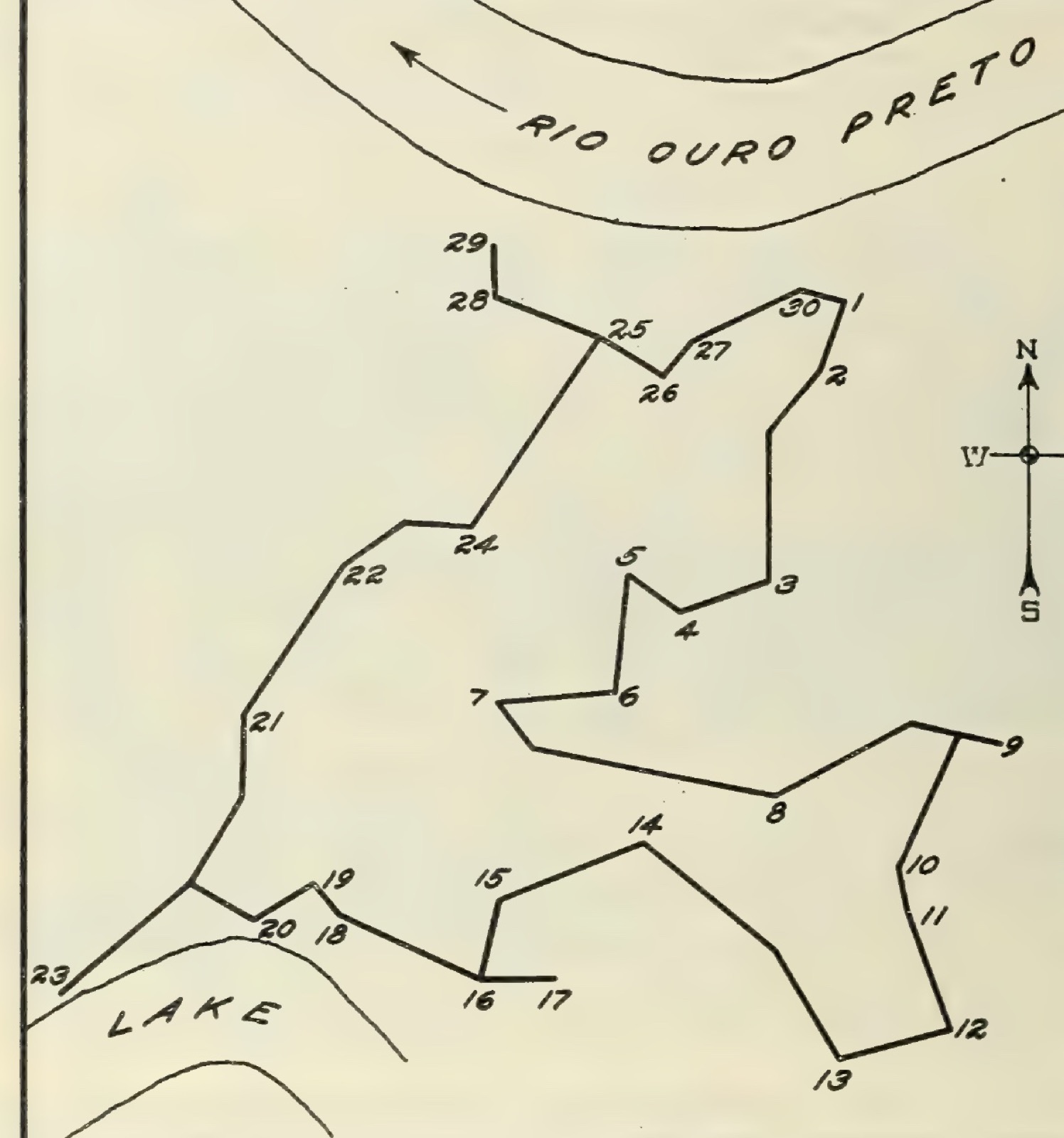
There was a third instrument, older than either, and it was not written down. It was the estrada, the tapper’s path. The seringueiro of the Amazon did not plant rubber; he walked to it. LaRue’s bulletin described the arrangement: a path cut through the forest from tree to tree, usually a hundred to two hundred trees long, walked before dawn and walked again with the cups. He quoted Akers, who had surveyed the trade for the British, that “in general the rubber trees are from 200 to 250 feet apart, which appears to be nearly correct”, and Lecointe, that the lower Amazon had eight to ten rubber trees to the hectare. For the Tapajós itself LaRue had a report by Raymundo Brasil: in the municipality of Itaituba, upriver from the Ford land, 287,045 trees were tapped in 5,407 estradas, “or 53 trees per estrada”, which he thought a small number. Nobody had arranged the forest that way. The fungus had, over a very long time, by killing the trees that stood too close to their neighbours. Two hundred feet was the distance the disease permitted, and every tapper on the river knew it with his feet. The plantation was going to put the trees ten to twenty feet apart.
Weir, it should be said, did not conclude in 1926 that plantations in the Amazon were impossible. “It is the writer’s opinion that when a thorough survey has been made of the available territory, regions will be found where Hevea may be grown without much danger of the profits being reduced by the action of this disease.” He named the conditions: sites chosen for wind and drainage, seed from healthy stock, the pathologist and the soil man choosing the ground before the planter. That was the survey nobody made. The site was chosen by a land deal, and the pathologist arrived in the sixth year.
What they built
The concession was of a million hectares, about 2,500,000 acres or 10,000 square kilometres, a tract the Times described in 1927 as three to four million acres and in 1930 as six million. The terms, as the geographer Joseph Russell set them out from the company’s records in 1942, gave the company the rights of a proprietor, freedom to build, import, export and settle without state supervision, and exemption from state and municipal taxes for fifty years. In return it undertook to plant rubber on 400 hectares in the first two years and 400 in each of the next two, to provide sanitation and schools, and after twelve years to pay a share of its net profits from rubber to the state and to the municipalities. Russell gives the shares as five percent and two; The Henry Ford’s account of its own records gives seven and two. “Many of the subsequent problems at Fordlandia,” Russell wrote, “generated in this planting guarantee,” because it meant “clearing and planting without adequate land inventory and planning.”
Two ships left the Rouge dock in Dearborn in the last week of July 1928, the Lake Ormoc and the barge Lake Farge, with a sawmill, a power plant, a tug, tractors, rails, an ice plant, and the material of a town. Oxholm, who had been sent ahead, reported a shoal in the Tapajós that nothing drawing more than nine feet could pass at low water, and advised waiting for the rains. The ships sailed anyway, reached the mouth of the river in September, and were unloaded at Santarém. Boa Vista, the site, lay 142 miles further up by the company’s own launch, which, the Times reported in March 1930, made the trip once a week in about sixteen hours when the water allowed.
The first year’s clearing was done in the wet season, when the felled forest would not burn, by Blakeley and Villares; the first year’s planting was done in the dry season by Oxholm, who had no experience of plantations, with seeds gathered in haste from the forest round about, to satisfy the 400 hectares in the contract. Most of it had to be ploughed under. A New Zealand paper that printed the company’s news in March 1929 reported “half a hundred acres” reclaimed and “the planting squads” moving over the cleared land, “starting the young rubber trees in regular rows.” The second planting, in early 1930, used seed that Rogge had gone up the Tapajós to get from the Munduruku, beyond the rapids, where the forest was rich in rubber and where, as it happened, the fungus was scarcer. By 1930, by the count of the Rubber Research Institute of Malaya, 3,000 acres had been planted, and by 1934, 8,300.
The rain was the first instrument the planters read, because it was the one they could not ignore. Russell printed the company’s gauge. The nine-year average at Fordlandia was 86.94 inches a year, within the range rubber wants, but 1929 brought 102.5 inches and 1930 brought 70. The dry season ran from July to October. The ground was not the plateau the plan had imagined but a dissected rim of flat-topped remnants, steep slopes and ravines, with rock on the hilltops and swamp in the hollows, and once the forest was off it the slopes washed. “The rough surface proved to be impossible rubber land,” Russell wrote under a photograph of it, “and resulted in the abandonment of large zones.” Terracing added $23.17 an acre to the cost of opening ground; cover crops in 1932 and 1933 cost $10,378.70; by March 1941 the company had condemned 3,425.95 acres of what it had cleared.
Around the clearing a town grew, and the town was the part the plan was sure of. There were shingled houses in the manner of Cape Cod along three avenues, concrete sidewalks, electric street lamps, red fire hydrants, a water tower, a sawmill that the 1932 visitor called the largest in South America, a hospital designed by Albert Kahn, the architect of the Rouge, a school, a cinema, a band of twenty-five, a golf course, and a dining hall. “The use of alcoholic drinks is absolutely not permitted, nor even of beers or wines,” the 1932 visitor wrote, though prohibition was no law of Brazil’s; the Times in 1930 reported the rule as “no women and no liquor”. On weekends there were square dances. Wages were the thing the company was proudest of and the press most suspicious of: 35 cents a day with board at the start, “considerably more than the prevailing scale”, raised by 1929 to a minimum of 65 cents for labourers and $1.50 for tradesmen; nine milreis a day by 1932, an eight-hour day, Sundays off, fifteen days’ leave. The visitor from Pernambuco called Ford “the man of predestination, almost a god”.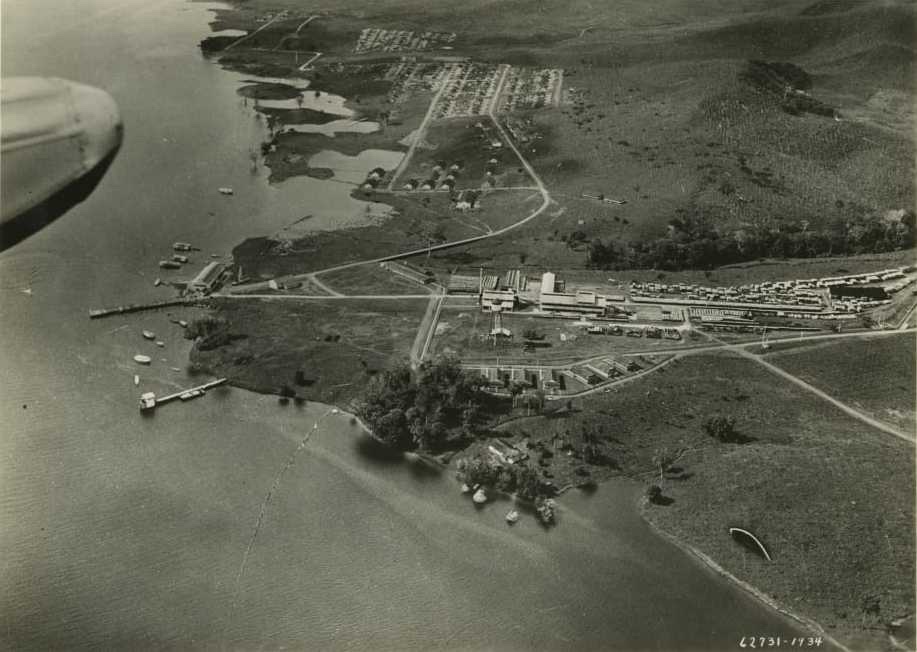
The men did not stay. “There is a constant turnover of labor on the Tapajos,” the Times correspondent wrote in September 1929, “as the majority of the caboclos work some three months, only with the expectation of using the $50 they have earned for a full year of comparatively luxurious idleness.” The camp was “under-staffed by at least 3,400 men all of the time”. When fifty West Indians were brought in, a caboclo was knifed, there was a strike, and the company removed all the West Indians at once. The food was too good: “fresh meat, butter, condensed milk, bread and green vegetables are luxuries that oftentimes sit uneasily on native stomachs accustomed to a regular diet of dried fish and meats”, and men were treated in the hospital for it. The correspondent’s remedy was the planter’s remedy everywhere, imported labour, “possibly Japanese”, which Brazilian opinion would not allow. LaRue had written in 1926 that the people of Pará disliked going upriver to work, and the plan had not read it.
Then the time clocks were smashed. On the evening of Monday December 22, 1930, the plantation replaced the waiters in its new concrete dining hall with a cafeteria line, on the suggestion of a foreman just arrived from the Rouge; clerks took badge numbers at the door to deduct the cost of meals from pay; the skilled men who had been served at table found themselves queueing in the heat with the labourers; a mason from Rio Grande do Norte named Manuel Caetano de Jesus took off his badge and handed it to the paymaster, Kaj Ostenfeld, and Ostenfeld laughed. The men who confronted Rogge afterwards told him, in the account Grandin found in the company’s files, “We are mechanics, masons, and carpenters, not table waiters.” By morning the dining hall, the office, the power house, the sawmill, the garage and the radio station had been wrecked, every truck and tractor on the estate disabled, and the time clocks broken to pieces; the Americans had spent the night on a tug in the middle of the river. The Associated Press, from Rio two days later, reported the trouble as an armed march by settlers the company meant to evict, with police flown in on a commandeered Pan American Airways plane; the two accounts are not the same event, and may both be true, because the evictions were real and the villagers marched in the days after the riot. Thirty-five soldiers arrived on Christmas Eve. On New Year’s Day the company paid every man “for all time up to and including December 22” and dismissed the labour force, keeping a few hundred. What the men had said with the time clocks, the company heard as a riot to be cleaned up, and cleaned it up. The whole of that week is told in the companion piece The time clocks.
Naked stems
Weir arrived at Boa Vista in March 1933, and the first thing he asked for was a book of standard practices. “Standard practices are as important in planting work as in the factory,” he wrote in his first report. “They insure uniformity of result.” He meant it as the Rouge meant it, and Johnston welcomed it. The estate’s planting was, one employee said, “as antiquated as the Model T”: seed from a mother bed ninety miles away up the Cupari, guarded against wild pigs, of unknown yield and unknown resistance. The plantations of Sumatra had been bud-grafting selected clones for a decade. Weir taught the staff to graft, and in June 1933 went to Malaya and Sumatra for stock. Early in 1934, 2,046 budded stumps from fifty-three of the best Eastern clones arrived at Fordlandia; 1,201 survived the voyage and the planting, which Johnston, not Weir, had done.
Then Weir changed his mind about the site. On his way out he had praised the work at Boa Vista and dismissed the worry that the land was too hilly. On his return in the middle of 1934 he told Edsel Ford to abandon it, and proposed a plateau seventy miles downriver and thirty miles from Santarém, flat, 150 feet up, a little drier, with deep friable soil and a river that steamers could reach all year. Johnston, who had just finished the town, objected to the word abandon. The company, Grandin writes, had spent six years and about $7,000,000 on an estate that nobody would take off its hands, and it took the expert’s advice. In May 1934 the State of Pará exchanged the remotest 281,500 hectares of the Fordlandia concession, by Russell’s figure, for an equal area on the river at a place already called Belterra. Fordlandia was to be kept as it was, as a research station and a source of budwood. The rows that had been planted were left standing.
In 1935 the crowns touched, and the fungus did what the bulletin said it would. “The spores hit the older groves the hardest,” is Grandin’s summary of Weir’s reports; the quotation from them is the one in the cold open, the branches ending in naked stems, the shoots shorter at every flush, the disease spreading “directly from tree to tree” with every change in the humidity. The morning fog off the river nurtured it. The nurseries were attacked, including the new budwood garden, and none of the Asian clones was resistant, because the fungus does not exist in Asia and nobody there had selected against it. Weir, who in 1933 had urged Johnston to plant the rows closer, now wrote that the disease could not be combated at Fordlandia. The Department of Agriculture’s own history of the period, written in 1955 by the men who ran its rubber programme, gives the result in one sentence: “During 1933-40, the blight devastated the Fordlandia plantation, comprising 7,500 acres that had been planted mostly with unselected seedling trees.” The seed had come from jungle trees along the Tapajós. The same history records that “scattered trees were observed to retain their foliage after the epidemic”, resistant or lucky, and that these were taken as clones; and that in 1936, at Fordlandia, Weir made the first trial in the Western Hemisphere of grafting a resistant crown onto a susceptible trunk, on some ten acres of seedlings and Eastern clones, with buds of Hevea guianensis. Fordlandia had become what Weir’s bulletin had asked for in 1926: a place where the disease was studied. It had cost the trees.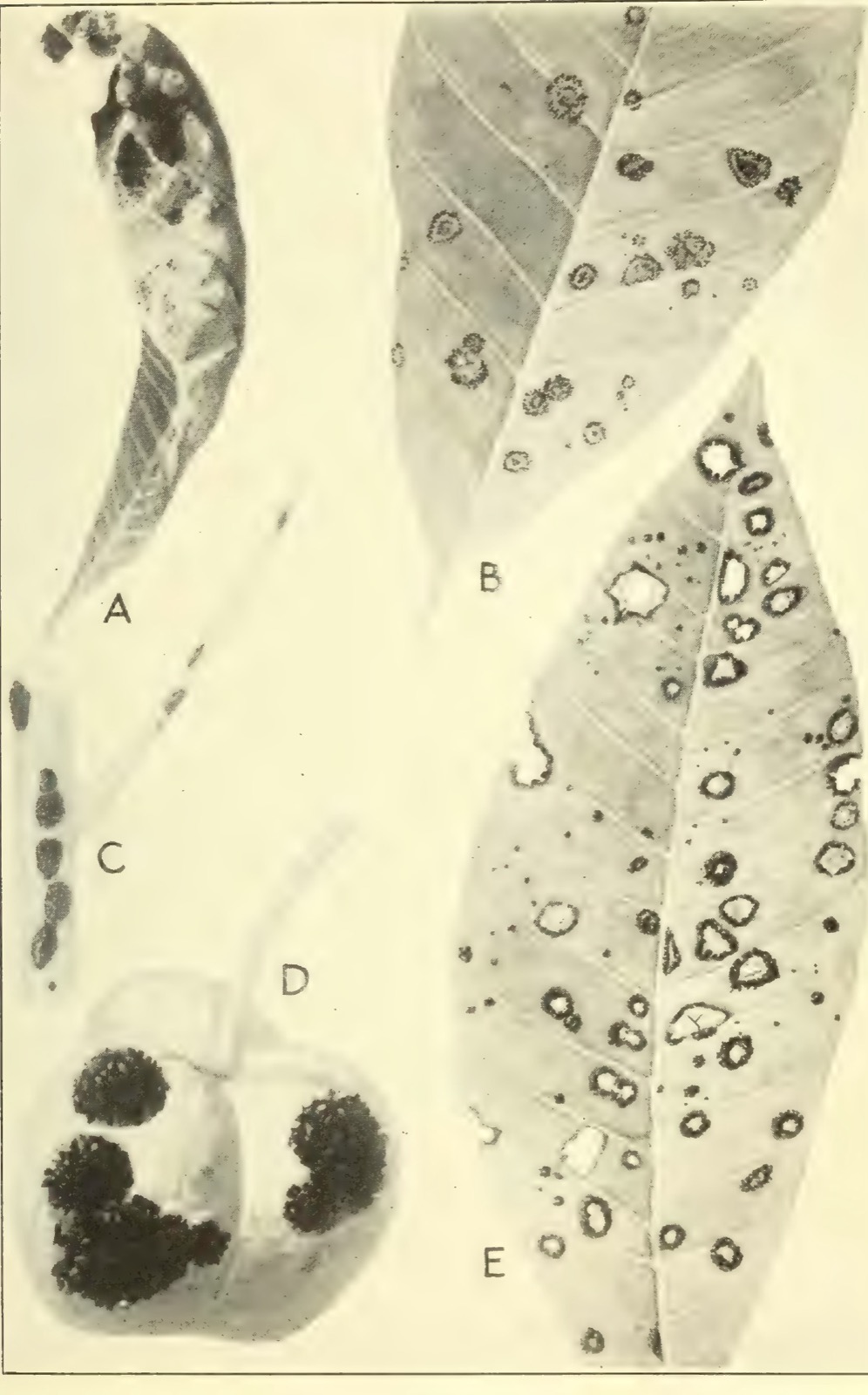
Johnston never forgave Weir, and said so to Dearborn for the rest of Weir’s four years with the company: that he came and went as he pleased, that he had misidentified the mites that destroyed the 1935 budwood, that the company had paid him $70,000 “and for this amount he has never assumed, or had to assume, any responsibility”. It is the quarrel of a plan with the one person on it who had written down what would happen, and it did not change what happened.
What it looked like from inside
Belterra was laid out as Fordlandia could not be, in straight lines on a forty-acre grid, with roads, tree lines and work units all squared to it. Russell printed the estate map and the surveyor’s profiles: no local relief, a dip of seven feet to the mile for drainage, no rock in 500 feet of drilling, the water table 375 feet down. The plan was to clear and plant 5,000 acres a year. The rate achieved, Russell found, was about 2,300. “The lack of a suitable labor supply has, however, proved to be a definite restraining factor.” The whole labour force of both estates in March 1941 was 2,723. A producing plantation of the 76,000 acres the company needed would want, he calculated, about 11,000 tappers and nearly as many others, and “neither the Amazon basin nor adjacent areas, including northeastern Brazil, can supply this need.”
From inside, the work was a war against insects. The company brought in the entomologist Charles Townsend to take an “insect census”, and he began with the lace bug, which laid its eggs under the leaf and whose larvae pierced the epidermis and sucked the young leaves dry. “The extensive planting of rubber,” he observed, “has created a greatly increased food supply and the bugs took advantage of it to multiply in proportion.” Then red mites, white flies, weevils, scale insects, and caterpillars of every description. When caterpillars took a block of Belterra’s first trees, every available person, men and women, was lined up to pick them by hand; in five hours they filled fifty one-gallon tins with an estimated 250,000 caterpillars, piled them, poured petrol on the pile and burned it. The chemists made insecticides from timbó, the fish poison, and from cassava. Johnston’s reports to Dearborn, in Grandin’s reading of them, became a weather diary: “The unusual dry weather continues.” In 1938 the gauge at Fordlandia read 64.7 inches, in 1939, 62.3.
The blight waited. Belterra was planted from 1934, and for four or five years it stayed clean, which the company read as the plateau’s good air. The Department of Agriculture’s history reads it differently: the trees “had not generally reached the age for ‘wintering,’ or annual leaf change, when the predominance of highly susceptible young leaves makes conditions most conducive for epidemic spread of the disease.” A rubber tree sheds its leaves once a year and puts out a new flush all at once, and in a plantation every tree does it in the same weeks. In the forest, two hundred feet apart, that is a tree’s own affair. In rows, it is a feast laid for the fungus on a single morning. Three years of devastating epidemics followed at Belterra before 1941, by the Department’s account; Grandin counts two by early 1942. Russell, writing from the company’s records at the turn of 1941, could still say that “experience in disease control gained at Fordlandia has prevented the inception of epidemics at Belterra”, and that leaf disease and the lace bug were “now under some sort of control” by grafting and spraying. He was describing the method. The leaves were describing the result.
By then the Department had a man on the estate, L. A. Beery, stationed at Belterra on a cooperative breeding programme, and in 1941 and 1942 he urged what Weir had tried on ten acres in 1936: cut the crown off every susceptible tree and graft on a resistant one. The company did it. “The Ford management then undertook the stupendous task,” the Department’s history says, “involving the decapitation, or pollarding, at a height of about 7 feet, of more than 2,000,000 trees, many of which were nearing tapping size.” Six hundred labourers were used, two hundred of whom became skilled budders; the shoots from the sawn-off trunks had to be sprayed until they were big enough to take a bud; by the end of 1945 the job was done, and then there would be two or three years’ wait for the new crowns. The tree that resulted was in three parts, a seedling root, a high-yielding Eastern trunk and a resistant crown, the “three-component tree” that the Department would make the basis of rubber planting across Latin America. By the end of March 1943 the plantation had top-grafted more than 820,000 trees and made some 60,000 hand pollinations; for a stretch of 1944 it was grafting tens of thousands of crowns a month.
In October 1942 Johnston came back from Dearborn to see “the greatest swarm of caterpillars that has ever been seen in this area”. The moths had learned to lay only on the new shoots at the tops of the trees, where the pickers could not see them, and the caterpillars came down the trees eating everything. The trees put out a second flush, and the blight took it, “the most severe attack in the history of the plantation”. Many had not the strength for a third. Some died halfway down the trunk.
The money and the rubber can be set side by side from Russell’s tables. By the spring of 1941 the company had invested, he found, something like $9,000,000; its expenses on both estates were running about $45,000 a month, four-fifths of it at Belterra. Shipments of creamed latex to the Ford tyre plant at Dearborn had begun years before, “but until recently such shipments have been small, such as 6,334.5 pounds in March, 1939, and 1,064 pounds in May, 1940.” In March 1941, 88,500 tappable trees at Fordlandia gave 35,015 pounds, and the estimate for the year was about a million pounds. Belterra had not been tapped. The company needed, by The Henry Ford’s count, 38,000 tons a year; by Grandin’s, fifty million pounds. “Present production,” Russell wrote, “is about 2,000 pounds of latex a day.”
What happened
Edsel Ford died on May 26, 1943, with the war on and the plantations opened to the Department of Agriculture as a wartime rubber source and a research station, and his father, who was seventy-nine, took the presidency back. The company’s board made Henry Ford II president on September 21, 1945. One of his first acts was to dismiss Harry Bennett. Another, on November 5, 1945, was to turn Fordlandia and Belterra over to the Government of Brazil for $244,200, which, Grandin says, was the sum the company owed its plantation workers in severance pay under Brazilian law. The Henry Ford’s account rounds it to $250,000. Decree-Law 8,440 of December 24, 1945, signed in Rio, set the terms on the Brazilian side: the Banco de Crédito da Borracha was to acquire “the assets of the concessions of Belterra and Fordlândia in the State of Pará, belonging to the Companhia Ford Industrial do Brasil”, free of any third-party claim, “at the price already agreed of 5,000,000 cruzeiros”, and was to take possession on December 31. The sum the company had put in is usually given as $20,000,000; The Henry Ford gives that figure, and Grandin, and Russell’s $9,000,000 to 1941 is consistent with it. The estates were valued at the sale, Grandin found, at nearly $8,000,000.
What had reached Dearborn in seventeen years was a few hundred tons of latex, most of it in the last three. The Henry Ford’s account says that the first commercial tapping at Belterra, in 1942, produced 750 tons; the Department of Agriculture’s history says that commercial tapping at Belterra began in 1948, three years after Ford left, when the grafted crowns had grown. Both can be true if the 750 tons were from the trees that were pollarded afterwards. By 1941, by The Henry Ford’s count, 3,651,500 rubber trees had been planted on the two estates. At the yield Grandin gives for Belterra’s blighted blocks, about 165 pounds of latex to the acre, half what a Sumatran smallholder got, the two plantations together would never have supplied a tenth of the company.
Henry Ford died on April 7, 1947, without having gone.
After
The estates passed to the Instituto Agronômico do Norte at Belém, and its director, the agronomist Felisberto Camargo, wrote the Brazilian verdict in a report to the United Nations. Fordlandia had been, in the phrases Grandin quotes, an “utter failure” through “blank ignorance” and a refusal to “test its theories by experiment”; and it was also “the true cradle of the technique of double grafting”. At Belterra, by the company’s departure, about two million trees on some thirty thousand acres carried grafted crowns, and Camargo expected the one plantation to yield a third of what the whole Amazon had at the height of the boom. It did not, because the world price fell, but it was tapped: commercial tapping, the Department’s history records, began in 1948.
The Department’s cooperative programme, which had come to Belterra in 1940, took the three-component tree to Costa Rica, Panama, Guatemala, Haiti and a dozen other countries, and in 1955 its directors, Rands and Polhamus, wrote that the Ford and Goodyear estates, “badly damaged by the South American leaf blight”, had “contributed invaluable material and experience”. The Rubber Research Institute of Malaya, surveying the same history in the same year, was blunter: the three big American plantations of the 1920s and 1930s “proved to be expensive and not very productive enterprises largely owing to South American leaf blight, but they provided invaluable knowledge and material.” The fungus was renamed Microcyclus ulei in 1962 and, after its genes were read, Pseudocercospora ulei in 2014, by a team at Viçosa who introduced their paper by calling it “the most serious threat to the natural rubber industry worldwide”, a threat “epitomized by the demise of Fordlandia”. Almost all of the world’s natural rubber is still grown in Asia, in rows, because the fungus has not got there. What the leaf and the fungus do to each other, and why the forest’s spacing beats both, is in the companion piece The leaf.
Fordlandia is still there, on its hills above the river: the water tower, the sawmill with its windows out, the power house, the hospital with its records on the floor, the three avenues of bungalows with rose bushes in front of them, and a cemetery with the crosses propped against a tree. People live in it. Belterra is a municipality of Pará with a library named after Henry Ford in the house where he never slept.
What it taught
A plan whose only instrument is its own method will measure its method. Fordlandia measured hectares cleared, trees planted, grafts made, houses built, meals served and hours punched, and every one of those numbers went up, and the plan read them as progress. The instrument that mattered was a leaf, and the leaf had been read, photographed and published in 1926 by the man the company hired in 1933. Bulletin 1380 said that pure stands intensify a parasite, that the Guianas had lost their plantations to this one, that the forest kept the disease in check by keeping the trees apart, and that any plantation in the valley should begin with a survey by a pathologist. Bulletin 1422 said the lower Amazon was not recommended, that labour would be short, and that control of the leaf disease must be studied before the planting and not after. The two hundred feet between a seringueiro’s trees said the same thing in a language the planters did not think of as knowledge. None of it was secret. It was for sale from the Government Printing Office.
The complication is that the plan was not stupid, only sealed. Rubber can be farmed in rows; Asia proved it with this tree, from this valley’s seed, and the proof is what the plan was built on. Weir himself believed in 1926 that sites could be found in the Amazon, and in 1933 urged closer rows. What Asia had that the Tapajós did not was an ocean between the tree and its fungus, and that is the single variable the method could not supply. Every technique the plan brought from Dearborn and Sumatra was sound somewhere else: the grid, the standard practices, the time clock, the cafeteria line, the bud graft, the clone. Applied to a biology that had already been written down, each of them made the disease worse, because each of them made the trees more alike and closer together, which is the one thing the bulletin had said not to do. The men who in 1930 smashed the clocks and said they were not table waiters were reporting the same fault from the other side: a method that could not take in information from the thing it was applied to.
And the plan did learn, in the end, by the only route left to it, which was to let the disease run and watch what survived. The scattered trees that kept their leaves at Fordlandia in 1935 became the resistant crowns on two million trees at Belterra by 1945, and the three-part tree became the basis of rubber planting in the Americas. That is a real result, and the Brazilian who inherited the place credited it. It is also, almost exactly, the experiment Weir had proposed in 1926 to be run first, on a trial plot, by a pathologist, before anything was cleared. The company ran it last, on 7,500 acres, with a town attached, for twenty million dollars, and got the answer the bulletin had printed for the price of a stamp. Two hundred feet was the distance between what the forest knew and what the plan was willing to read, and the leaves measured it every season, until someone looked.
Sources
- James R. Weir, A Pathological Survey of the Para Rubber Tree (Hevea brasiliensis) in the Amazon Valley, United States Department of Agriculture, Department Bulletin 1380, Washington, issued May 1926. The dates of the 1923 expedition; the history of the leaf-blight from Ule and Hennings through the Guianas and Trinidad, Bancroft and Rorer; the intercrops passage with the cabbages; the pure-stand and jungle-screen sentences; the control, exclusion and immunisation sections; Weir’s opinion that regions would be found; and Plate XV. archive.org
- Carl D. LaRue, The Hevea Rubber Tree in the Amazon Valley, United States Department of Agriculture, Department Bulletin 1422, Washington, 1926. The estrada, Akers’s 200 to 250 feet, Lecointe’s eight to ten to the hectare, the Itaituba count of 287,045 trees in 5,407 estradas, the labour passage, the leaf disease passages, the lower Amazon not recommended, the Tapajós as a report, the summary, and Figure 3. archive.org
- “Ford Gets Big Area to Grow Rubber: Forms Company in Brazil to Develop 4,000,000 Acres in Para Under Concession,” The New York Times, October 12, 1927, with Edsel Ford’s statement of October 11: the three to four million acres, the planting condition, Ide, Blakeley and Villares, Firestone, and “the work will begin at once.” The Times issues here were read in the scans on archive.org, mostly from the OCR text, which can drop short words; Edsel Ford’s statement and Henry Ford’s of 1928 were checked against the page images, the rest were not. archive.org
- “Auto Maker to Visit Para,” The New York Times, November 16, 1928, with Henry Ford’s statement of November 15: “The plantation is bound to succeed,” the intention to visit Pará, and the 590 miles from Belém. archive.org
- L. Palacios Mendiburu, “…by Labor Scarcity: But Development on Amazon River Proceeds Rapidly Despite Many Obstacles,” The New York Times, October 20, 1929, written from Belém on September 16; the first words of the headline are illegible in the scan. The Villares and Greite concession, the transfer of July 21, 1927, the price, the 1,600 of 5,000, the 35 and 65 cents, the food, the West Indians, the turnover and the $50,000 a month. archive.org
- “City That Lost Chance Offered It by Ford: Santarem in Brazil Sees Belem Supplanting It as Second City of Para,” The New York Times, March 2, 1930, written from Santarém on January 29: the launch, the 142 miles and sixteen hours, and the capital of Fordlandia. archive.org
- “Armed Brazilians Raid Ford Rubber Plantation; Police Are Sent by Plane to Enforce Evictions,” Associated Press from Rio de Janeiro and Detroit, December 24, in The New York Times, December 25, 1930: the eviction order, the orphan asylum, the commandeered plane, “no women and no liquor,” the six million acres and the six billion pounds. archive.org
- “Fordlandia Rises as Industrial City in Amazon Jungle,” Manawatu Times, Palmerston North, March 2, 1929, for the first fifty acres and “regular rows.” paperspast.natlib.govt.nz
- W. G. N., Fordlandia, ou a descrição da cidade maravilhosa que Henry Ford está edificando no interior do Estado do Pará, Tipografia Norte Evangélico, Garanhuns, Pernambuco, April 1932: the 2,000 souls, the ninety-four percent, John Rogge, the sawmill, the dry law, the wages of nine milreis, the eight-hour day and fifteen days’ leave, the band of twenty-five, the cinema, the 200 men clearing ninety kilometres upriver, and “almost a god.” Translated here. archive.org
- Joseph A. Russell, “Fordlandia and Belterra, Rubber Plantations on the Tapajos River, Brazil,” Economic Geography 18 (2), April 1942, pp. 125–145, compiled from the records of the Companhia Ford Industrial do Brasil: the concession’s terms and shares, the 1934 exchange of 281,500 hectares, the rainfall tables, the terrain, the terracing and cover-crop costs, the condemned acres, the Belterra grid and well, the diseases “under some sort of control,” the tables of equipment, payroll, acreage and trees, the latex shipments, the $9,000,000, the 76,000 acres and 11,000 tappers, and the labour force of 2,723. archive.org
- Robert D. Rands and Loren G. Polhamus, Progress Report on the Cooperative Hevea Rubber Development Program in Latin America, United States Department of Agriculture, Circular 976, 1955: “During 1933-40, the blight devastated the Fordlandia plantation”; the scattered survivors; Belterra’s wintering; Beery’s recommendation; the pollarding of 2,000,000 trees; Weir’s crown-budding of 1936; the three-component tree; and commercial tapping in 1948. archive.org
- R. N. Hilton, “South American Leaf Blight: A Review of the Literature Relating to Its Depredations in South America, Its Threat to the Far East, and the Methods Available for Its Control,” Journal of the Rubber Research Institute of Malaya 14, July 1955: the 3,000 acres by 1930 and 8,300 by 1934, the 2,046 buddings from fifty-three clones and the 1,201 survivors, Belterra’s 12,230 acres by 1939, and “expensive and not very productive enterprises.” archive.org
- Decreto-Lei nº 8.440, de 24 de dezembro de 1945, Estabelece normas para aquisição pelo Banco de Crédito da Borracha S.A., do acervo das concessões de Belterra e Fordlândia: the price of five million cruzeiros, the exclusions, and possession on December 31, 1945. Translated here. camara.leg.br
- Braz Tavares da Hora Júnior and others, “Erasing the Past: A New Identity for the Damoclean Pathogen Causing South American Leaf Blight of Rubber,” PLoS ONE 9 (8), 2014: the history of the names from Hennings to Pseudocercospora ulei, “the most serious threat,” and “the demise of Fordlandia.” doi:10.1371/journal.pone.0104750
- The Henry Ford, “Ford Rubber Plantations in Brazil,” a research topic page drawn from the Benson Ford Research Center’s collections: the concession of July 21, 1927, the shares of seven and two percent, the 2,046 buddings, the 3,651,500 trees by 1941, the 750 tons of 1942, the 38,000 tons needed, the $20,000,000, and the $250,000. thehenryford.org
- Greg Grandin, Fordlandia: The Rise and Fall of Henry Ford’s Forgotten Jungle City, Metropolitan Books, 2009. In copyright, and quoted here only in short phrases. It is the source, from the Ford archives, for Weir’s reports of 1933 and 1935 (“naked stems,” “every change of humidity,” “standard practices”), the $125,000 and the ratification of September 30, 1927, the ships’ sailing, Oxholm and Rogge, the riot of December 22, 1930 and the words of the mechanics, the exchange of May 1934, Johnston’s complaints about Weir, Townsend’s insect census, the caterpillar bonfire, the swarm of October 1942, the 165 pounds an acre, the sale of November 5, 1945 and the $244,200, Camargo’s report, and the travel guide. Every quotation from a Ford document in this entry comes at second hand through Grandin. archive.org
- Benson Ford Research Center, The Henry Ford, finding aids: the Companhia Ford Industrial do Brasil records (accessions 74 and 301), the James R. Weir papers (accession 1514), the W. L. Reeves Blakeley records, and the Fordlandia photograph albums (accessions 95.34.1 and 1830). Not consulted; listed for whoever can. askus.thehenryford.org
- The figures: Figure 3 of Bulletin 1422 and Plate XV of Bulletin 1380 are US government works, and were published in 1926 besides. The aerial view of 1934 is The Henry Ford’s object 84.1.1660.P.833.62731, a Ford Motor Company Photographic Department print; Wikimedia Commons holds it as public domain on the basis that it was published without a copyright notice in Russell’s article of 1942, and the credit line on The Henry Ford’s record is “From the Collections of The Henry Ford. Gift of Ford Motor Company.” commons.wikimedia.org, thehenryford.org
