At about ten o’clock on the morning of Wednesday 10 December 1952, a man who had not spoken to another human being for fifty-two days looked out from under the tent of a rubber dinghy and saw a cargo steamer two and a half miles off on the starboard quarter. He flashed a heliograph at her bridge until someone saw it. She altered course, ran up a Union Jack and dipped it three times, the salute for a warship met at sea, and when the two were abeam her captain switched on his loud hailer and asked whether he needed any assistance.
“Just the time, please, and my exact longitude,” the man called back.
The answer put him ten degrees of longitude, six hundred miles, east of where his own sextant had put him. He had been at sea for fifty-three days and believed himself a few dozen miles from Guadeloupe. He was nowhere near it. He sculled across to the ship’s side muttering that it was over, climbed the ladder, took a fresh-water shower, and was given a fried egg, a small piece of liver, a spoonful of cabbage and some fruit. Then he climbed back down the ladder into the dinghy and sailed on for another twelve days.
The ship was the Arakaka of Liverpool, bound for British Guiana. The man was a French doctor of twenty-eight named Alain Bombard, and the dinghy, which he had named L’Hérétique, was carrying no food and no water except what he could take from the sea, and a sealed box of emergency rations that he intended to land unopened. Thirteen days later, on a beach on the north coast of Barbados, he did. Five days after that, the news agencies reported that he had “admitted” a cooked meal in mid-ocean, and printed his answer: “But that was only one day in 65. It makes no difference to my theory.”
That sentence is the whole argument of this entry. One day in sixty-five is a small fraction. It is also the only day of the sixty-five on which anyone but the subject saw what the subject ate.
Who ran it
Alain Bombard was born in Paris on 27 October 1924 and entered the Paris medical faculty in 1943, in the middle of the occupation. He was a strong swimmer who trained for the Channel races of 1951. That spring he was a house surgeon at the hospital of the fishing port of Boulogne-sur-Mer, and early one morning the telephone woke him in the residents’ quarters. A trawler, the Notre-Dame-de-Peyragues of Équihen, had missed the harbour mouth in mist and struck the outer end of the Carnot breakwater. The casualty ward filled with the men of her crew, “like dislocated puppets, their feet bare, and each still wearing a lifebelt,” he wrote, and not one of them could be revived. Forty-three men had drowned within sight of a wall with a ladder every twenty yards along its face, and seventy-eight children had lost their fathers.
He made the port’s dead his subject. Boulogne alone, he found, lost between a hundred and a hundred and fifty fishermen a year. In peacetime the sea killed about 200,000 people a year worldwide; about half of those died on the coast, where lifeboats could reach them; of the rest, some 50,000 died more or less as their ship went down, and another 50,000 reached a boat or a raft and died afterwards. “Several thousand widows less per year seemed to me an objective fully justifying the risk of one life.”
He had no money and no institution. In the autumn of 1951 a Dutchman, an expert in salvage and life-saving gear who weighed, Bombard says, twenty-five stone, offered to pay for six months of laboratory work; the book never names him, and a feature writer in 1953 called him Jan Schat. On 19 October 1951 Bombard presented himself at the Musée Océanographique in Monaco and was given a bench. A fellow Channel swimmer, Jean van Hemsbergen, had already taken him to Folkestone and back in a prototype inflatable called the Hitch Hiker, and on 3 October 1951 the two had spent two days and three nights adrift off the Somme when its motor failed. The man who sailed with him in the end was an Englishman found through the newspapers: Herbert Muir-Palmer, known as Jack Palmer, a naturalised Panamanian yachtsman stranded in Monaco without money. “Dr Bombard, I am your man,” Palmer said, after a few hours’ thought.
The French authorities took an early interest, and not a kindly one. For leaving territorial waters in a beach craft without a navigation permit he was fined in his absence; when he went to court to argue, the prosecutor called him “an irresponsible, hoaxer” whose experiment “only exists in his own imagination.” He named the boat after the reception.
What they were trying to find out
The hypothesis was two claims under one name, and Bombard said so. The first was physiological: that the sea contains everything a human body needs to stay alive for weeks, if the body is made to take it. Fish are mostly water and their flesh is poor in salt; pressed, six or seven pounds a day would yield the day’s drinking. Fish supply protein and fat, and vitamins A, B and D; plankton, the drifting life that whales live on, would supply vitamin C against scurvy. And for the first days, before the fish came, when the body’s water must be kept up or the later catch would not restore it, there was one source left. “The only solution is to drink sea-water.” Everyone knew sea water killed. Bombard’s calculation was that it killed by dose: the daily allowance of salt a body could pass, taken as sea water, came to “about a pint and a half of sea-water a day,” and the kidneys could stand that for about five days before the risk of nephritis became acute.
The second claim was psychological, and he thought it the larger. The sea, he argued, killed castaways faster than hunger or thirst could. “Statistics show that ninety per cent of the survivors of shipwreck die within three days, yet it takes longer than that to perish of hunger and thirst.” Those men had been “killed, not by the sea, not by hunger or thirst, but by their own terror.” The way to keep a castaway alive, then, was to give him something to believe: that the sea was not sterile, that an inflatable raft would last more than the ten days the experts allowed it, and that a man had already done the thing he was being asked to do. “Thirst kills more quickly than hunger, but despair is a greater danger than thirst.”
Every official text on the subject said the opposite of the first claim, and said it in capitals. The United States Army’s and Air Force’s manual Survival at Sea, issued in June 1950, puts water first: “Do not drink salt water, as this will cause diarrhea, weakness, and unbearable thirst. Delirious men may have to be restrained from drinking salt water.” The Air Force’s new Survival manual, dated December 1952, the month Bombard reached Barbados, covers both of his sources in a sentence: “Don’t drink body fluids of fish, urine, or salt water. They are dangerous.”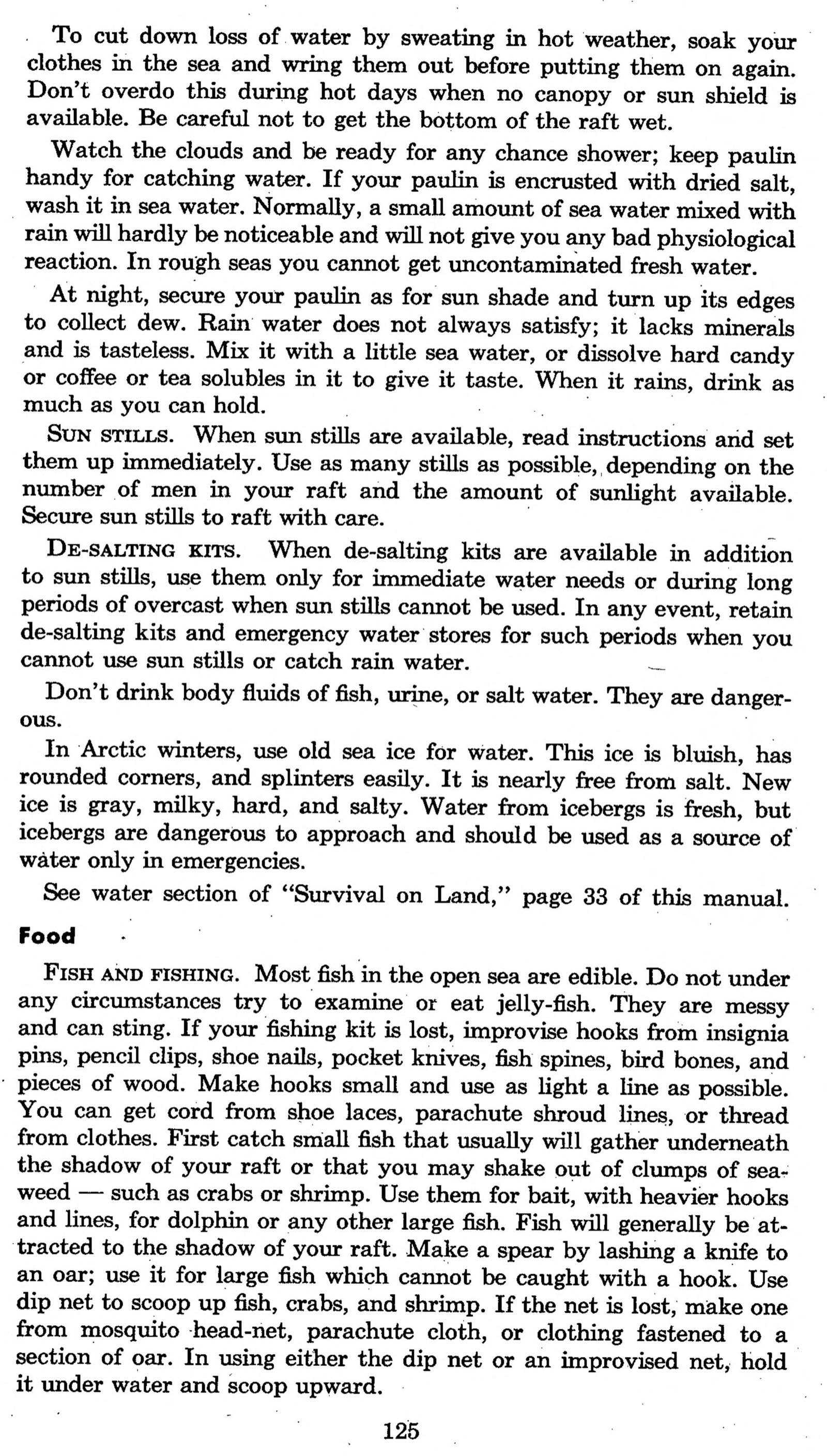
The British position was more careful and came to the same place. In 1943 W. S. S. Ladell, at the National Hospital in London, had given volunteers on a lifeboat ration up to 400 cubic centimetres of sea water a day for the Medical Research Council and reported “a slight gain to the body of water,” and the Council’s committee had added a footnote to say that it did not, all the same, recommend drinking it. In July 1952, as Bombard reached Tangier, G. R. Hervey and R. A. McCance of Cambridge told the Royal Society that 150 millilitres a day had improved six fasting men’s water balance on the third day and raised the salt in their bodies, and judged the effect “deleterious”: a gain that “would eventually have been replaced by a loss.” Bombard had gone to England in the spring and been introduced to doctors of the Navy and the Air Force, who “made both their interest and (when they had any) their doubts very clear.” He twice missed meeting McCance.
So the first claim was an argument about quantity, and the second was an argument about courage, and the experiment he designed could test only one of them, and only on one man.
What they built
The boat came from the makers of the Hitch Hiker, and its designer, the airman Debroutelle, saw to the last details in Monaco harbour. It was, Bombard wrote, “a sort of horse-shoe shaped inflatable rubber sausage, some fifteen feet long and six feet wide,” the open end closed by a wooden stern-board. The floats were divided into five compartments with a valve between them; the bottom was flat, with a light wooden deck, a rigid keel, two lee-boards and a dinghy sail “of about three square yards” stepped too far forward to point into the wind. There was not a piece of metal in her. Later accounts give her length as 4.3, 4.5, 4.6 or 4.65 metres, and name her makers, whom Bombard does not, as the firm that became Zodiac.
What she carried was the point. A sextant, a compass, a Pilot Book, tables and charts; a plankton net and a small parachute that served as sea anchor and as net; fishing lines and a harpoon gun; cameras, flares, a heliograph, a smoke bomb; a first-aid box in which, Bombard says, he kept a few antibiotics he meant not to use; books and scores, from Rabelais to the Bach Passions; a wireless receiver, presented to him in Casablanca; and the sealed boxes. The food was in a crate marked “rations.” Before the Mediterranean trial an official came to the quay at Monaco to seal the jerry-cans of emergency water; before the Atlantic crossing the French consul’s office at Las Palmas checked and sealed the stores. The seals were the only part of the design that another person could inspect, and Bombard made a point of showing them: at Ciudadela in Minorca, where a Spanish naval officer greeted the boat with “Eh bien, Messieurs, vive la France!”, he “asked him to note that the seals on our emergency food stocks were unbroken.”
The rehearsal was the Mediterranean, “so deceptively like a lake,” chosen to test crew and gear before the ocean did. L’Hérétique was towed out of Monaco at five in the morning on Sunday 25 May 1952 with Bombard and Palmer aboard. They drank sea water from the start, Bombard from the first day and Palmer, who could not bring himself to, from the second afternoon, when his tongue was already dry; they caught a sea perch on the third day and nothing for the next five; a storm blew them back into the Gulf of Valencia. On 7 June, the fourteenth day, they stopped the liner Sidi Ferruch with a smoke bomb and asked for “a few emergency rations,” which came down in a sack with water. Bombard never touched the sealed boxes, which were for the Atlantic; he took the ship’s food and reported it, and the French papers announced that the expedition had failed. They landed at Ciudadela on 11 June, capsized under tow a week later, and reached Tangier by steamer in July, where Palmer, “the perfect crew” at sea, found reasons every day not to leave the shore.
Bombard’s summary of those fourteen days is the first page of the medical log that matters. He and Palmer drank fish juice on four of them and sea water on ten, in two stretches “bringing us to the safety limit.” Urine normal, no vomiting, no diarrhoea, no motion at all for eleven days; dry skin; an abscess at the jaw that he lanced with his pocket knife; cuts that would not heal. Blood pressure “hardly varied,” though he notes that the experiment had not lasted long enough for that to mean much.
On Wednesday 13 August, with Palmer in Tangier buying things and the last favourable wind running out, Bombard left a note (“I am taking the responsibility of leaving alone. Success can only come if we believe in it.”) and put to sea by himself. He fought the current through the Straits for a night and a day, and on 15 August, two days out, “began to keep a daily record of my blood pressure and pulse.” He reached Casablanca on the twentieth, found a tow out on the twenty-fourth when the yacht club’s president had forbidden its members to give him one, and eleven days later, by sextant and dead reckoning, came ashore between two reefs at Castillo del Romeral on the Grand Canary, on 3 September. A telegram was waiting with the news that his daughter Nathalie had been born. He flew to Paris, paid eight thousand francs in court costs to stay out of prison, flew back through Casablanca, where the naval commander in Morocco, Admiral Sol, questioned him for a morning and then said, “We understand what you are after and we are going to help you,” and on 18 October the wind at Las Palmas came round to the north-east.
Fifty-three days
He left Puerto de la Luz on Sunday 19 October 1952, towed out by a French yacht past the Spanish navy’s training ship, whose cadets stood along the rail and took off their caps as he passed. The Press Association’s cable that day said that “a 27-year-old Frenchman, Professor Alain Bombard, left here today on a rubber raft to attempt to drift alone across the Atlantic — without touching fresh food or fresh water while he is at sea.” He was not a professor, but the rest was right: he meant to live on the fish he caught and on “a mixture of fish juice and sea water.”
The log for the third day reads: “Morale excellent, but sun hot. Very thirsty. Drank a little sea-water as the fish are still sulking; have only been able to catch about three pounds, quite insufficient to provide fresh water.” That night a breaking wave filled the dinghy to the floats and he baled for two hours with his hat. On the twenty-third the sail that had carried him from Monaco tore across, the spare sail blew away with its rigging, and he spent the day sewing the old one with black thread. On the twenty-fourth he bent the point of his knife on an oar to make a harpoon, and on Saturday the twenty-fifth, the seventh day, he caught his first dorado. Behind its gill cover was a natural bone hook; from then on he had bait, hooks, food and drink, and “was never in danger of starving.” The fish never left him. Flying fish fell on the tent at night, five to fifteen a morning. The experts of Las Palmas had told him there were no fish in the open Atlantic, and his argument with them runs through the log like a second voyage.
Then the daily ritual settled. At dawn, collect the flying fish and eat the two largest. Fish for an hour. An hour’s inspection of the boat, running his fingers along the floats and putting his ear to the rubber like a stethoscope. Half an hour’s exercises. Ten or twenty minutes with the net for the two coffee-spoons of plankton he took as medicine. Noon, the sextant. Then the hours he gave to his own case. “At two o’clock I gave myself a complete physical check-up; blood pressure, temperature, state of the skin, nails and hair, condition of the mucous membranes; noting the sea and air temperatures, humidity and weather conditions. Then I subjected myself to a sort of examination of my state of mind and morale.” In the evening, “measurement of urine, muscular strength, stools passed,” the day’s catch and the day’s plankton.
The body’s returns came in on schedule. On the tenth day: “Have lost the nail of the small toe of my right foot, and there is a strange rash probably due to the salt on the backs of my hands,” and, in the same entry, the rule: “I have a few antibiotics on board, but if I use them, future castaways may object that they had no medicaments.” On 28 October his watch stopped, so that the times in the log were thereafter guesses and his longitude, which depends on time, became a thing he believed rather than measured; the same day he noted, “I am not dreaming about food; a good sign.” On 4 November his urine was “still perfectly normal.” By the sixth he had diarrhoea, which “certainly did not come from drinking sea-water, as it was some time since I had found this necessary.” The privation he wrote about was not thirst: “My worst privation is undoubtedly the lack of real fresh water. I am sick of eating raw fish, but even more tired of drinking its juice.”
Rain came on 11 November, after twenty-three days, a tropical downpour that filled the tent between his knees. He spat out the first fill, salt from the canvas, and drank the second. “For three weeks I had not had a drop of fresh water, only the liquid I pressed from my fish, but my reactions were perfectly normal.” From then on he had rain, often more than he could store. Then, on 16 November, the sun came out, his skin broke into pustules, he lost the nails from four toes in three days and lanced the pus under half his fingernails without anaesthetic, keeping the penicillin unopened to the end.
What killed the voyage, nearly, was not the sea but his sums. He had timed his first noon sight, in a rough sea on the second day, forty-five minutes wrong, and every longitude after it was wrong by about ten degrees. By 16 November he thought he had about five hundred miles to go, and wrote that he would land “between Saturday 22nd and Saturday 29th November.” On the twenty-third a line squall tore through, then the trade wind stopped. For twenty days the sail flapped. He read the signs of land in the castaways’ handbook he had brought, and saw them all: frigate birds, tropic birds, a butterfly, a fly, a gossamer thread, floating bark, a lamp bulb. None of them was land. “Forty days is enough for any man,” he wrote on 27 November, and underlined it. On the thirtieth, diarrhoea twenty times a day; on 1 December, blood in it. On the second: “Am beginning to lose hope completely.” On the fifth: “I hardly dare to eat anymore; if this goes on, the boat may arrive, but they will find me in it dead.” On the sixth he wrote his will. “My thesis holds good for a duration of fifty days. If I am dead on arrival, there is no need for other castaways to despair. After that period, the strain on the human system is too great.”
The entries of those days are the record of the second hypothesis being tested on its author, and he knew it. His blood pressure, he wrote afterwards, “remained more or less normal until the beginning of December and became dangerously low as my despair increased after that date.” On the seventh, thirsty under a cloudless sky, with a gallon of rain left and the sea water he could not face with the diarrhoea: “and to think how much I have thrown overboard! Barrels and barrels of it!” On the eighth he looked at the one thing in the boat he had not used. “If things come to the worst, I always have my reserve stock of emergency food, but once I have eaten that it would be all over.”
What it looked like from inside
Bombard was the subject and the only observer, and the instrument was a notebook. What the log could hold, it held: weight he could not measure aboard, but blood pressure, pulse, temperature, urine, stools, skin, nails, grip and the state of the mucous membranes, every day for sixty-five days, and the weather and the catch beside them. What it could not hold was anything that would have let another doctor say what the numbers meant: a second man on a different ration, a measured intake of sea water instead of a few sips “in accordance with the figures for safe absorption that I had worked out,” a reading of the blood before the fourteen days of sea water and after them, a scale.
He did test the Mediterranean regime on two men, and the second man refused the water on the first day and took it on the second, after which the one difference between them was the thing under test. He did not seal the log-books on landing, and wrote that he had been “reproached for not immediately placing my log-books under seal, as proof that I had had no time to falsify the entries.” His answer was to ask “how much can be expected from someone who has just reached land after sixty-five days of total isolation and immobility,” which is true and is not an answer.
The log is also the best record anyone has of what despair does to a man alone in a small boat, and here it is not a control that is missing but a comparison. By his own account, the food was never short after the seventh day; the water was never short after the twenty-third; the boat never came near capsizing. What ran out was the belief that it would end, because his longitude lied to him for seven weeks. The man who had written that castaways die of terror found, with the fish round him and rain in the mattress, that he was dying of a navigational error, and he wrote down what that felt like at two o’clock every afternoon. “It is frightening to realise to what extent one can develop a persecution mania alone on the surface of the sea.” He drew up three alternative menus, with the wines, for the dinner a friend who had bet against him would owe. He played a game with his damp matches in which the number of strikes it took to light one became the number of days to land, and when it took too many he discounted the result.
On 10 December the Arakaka gave him his longitude and he gave up, for the time it took to shower. “You have to hand it to the French,” one officer said to another in the passage, “they will try anything,” and that, he says, decided him. He asked Captain Carter for the Pilot Book for 1953, since on his new reckoning he would still be at sea in January, and was given it, with a fresh battery for the wireless and the time. Carter asked whether he would not like a meal. “I declined vigorously, but he insisted: ‘You can’t refuse a hot meal.’” He ate the egg, the liver, the cabbage and the fruit, sent a telegram to his wife, and was back in the dinghy within an hour and a half. “I have to admit,” the log says that night, “I very nearly stayed on board.”
The meal did what he had predicted a meal would do. For fifty-three days he had not been hungry; now he was, and his appetite for fish was gone. “I lost more weight,” he wrote, “during the twelve days still remaining to land than in the fifty-three days prior to my meeting with the Arakaka.” The diarrhoea, on the other hand, stopped overnight. He called the effect “psychological hunger,” “a desire for something else, always dangerous when the something else is not available,” and offered it as his best evidence for the second hypothesis. A nutrition expert in Paris told him afterwards that had they known about the meal “we would not have rated your chances of survival very high.”
What happened
On 22 December he let off his last two flares to stop a Dutch freighter bound for Trinidad that had already circled him once. “We passed quite close,” her captain told him over coffee, “circled right round you, and not seeing any sign of life we assumed that it was an abandoned dinghy and continued on our way.” She put him at 13° 50’ north, 58° 20’ west; the agencies would report that she also gave him bread and a sausage, that he gave the bread away on the beach and still had the sausage. At half past midnight he saw the double flash of the North Point light on the clouds, spent the morning of 23 December working the dinghy through the surf of the north coast, counting the seventh waves, and at last swam the final twenty yards with the anchor.
On the sand, the first thing he did was to find witnesses. The crowd had seen the crate. “When they saw on it the word ‘rations’ they shouted, ‘Food! Food!’” He chose the local schoolmistress and lay preacher, and the policeman, had them see that the seals were unbroken, and then, he writes, “handed round my American tinned food, which was received with delight.” The sealed box of rations, the one object in the experiment that could have been examined by someone else, was eaten on the beach by people who had not been aboard, in front of the witnesses who had certified it. The agency version is shorter: “He also gave the natives the canned rations he carried in case of emergency, Dr. Bombard said.”
That evening in Bridgetown he had himself examined by a local physician, David Payne. The figures he published from that examination are the end of the log. “I lost fifty-five pounds in weight,” twenty-five kilograms. “My red corpuscle count was five million at the start and two and a half million on arrival,” and the haemoglobin was at the safety limit. Fourteen days of diarrhoea with “sizeable haemorrhages,” 26 November to 10 December. Two near-faints, on 23 November and 6 December. A rash over the whole body, toenails gone, “serious defects of vision,” loss of muscle tone, and hunger. No sign of any vitamin deficiency, which he took as proof of the plankton. And the water account, closed: “I had no rainwater for the first twenty-three days. … After leaving Monaco, I drank sea-water for fourteen days in all and fish juice for forty-three days. I had conquered the menace of thirst at sea.”
The verdict he wrote for the book, published in French as Naufragé volontaire and in English as The Bombard Story within the year, does not hedge. “I claim to have proved that the sea itself provides sufficient food and drink to enable the battle for survival to be fought with perfect confidence.” He wanted a map of winds and currents printed on the floor of every life-raft, and under it the words “Remember the man who did it in 1952.” Captain Carter cabled him in Bridgetown: “Congratulations to a gallant gentleman who had so much courage in his convictions to carry on when safety and luxury were proposed.”
The attacks, as Bombard called what followed, began with the wire story. The Australian Associated Press’s despatch from Bridgetown, printed across Australia on 29 and 30 December, opens on the word “admitted”: he “admitted yesterday that he had one cooked meal during the 65-day voyage,” and “since his arrival in Bridgetown he has complained continually of being tired, and has had trouble with his gums.” His reply, “But that was only one day in 65. It makes no difference to my theory,” is the headline of this entry because it is the defence of every self-experiment: that the breach was small and the subject says so.
The medical press took him seriously and said what it could. The Lancet, reviewing the book on 7 November 1953, set out the claim in his own figures, “50,000 persons a year die as castaways, 90% of them from despair in the first three days,” and the method: “He took emergency rations but never opened them. … He recorded daily his blood-pressure, his temperature, and the state of his skin, nails, hair, and mucosae.” It noticed the meal, “which gave him the worst stomach trouble of the whole voyage but apparently cured his enteritis,” and then, allowing that other castaways “might succumb to seasickness or be otherwise incapable of keeping themselves alive as he did,” gave him the point: “by enterprise and endurance he has made his point and has made it in a way that must cause more attention to be given to the needs of survivors from shipwreck.” The sentence is careful. It is the morale, the enterprise and the endurance, that have been demonstrated. The pint and a half is not mentioned.
The real control arrived three years later, and it was not a man in a boat. In 1956 the Medical Research Council published McCance’s report The Hazards to Men in Ships Lost at Sea, 1940-44, an analysis of 448 wartime sinkings and 27,000 men and women. The British Medical Journal’s summary gives the water table in a line, “Of 113 men on voyages lasting from 3 to 15 days with no water available, 57 died—53 in less than 6 days,” and then: “The report makes no mention of attempts to supplement water supplies by fish juice—a practice of questionable value recommended by A. Bombard—but sea water was drunk in unspecified quantities on some voyages. The mortality of the sea-water drinkers was 38.8%, ten times that of those who drank only fresh water.” The journal allowed that “with so many other factors involved this theory can be neither proved nor disproved from the information available.” The men who drank sea water in 1942 were, as a rule, the men who had run out of everything else, and drinking it late and in quantity was exactly what Bombard said would kill. Nothing in 27,000 case histories could test a dose that almost nobody in a lifeboat had measured.
The counter-experiment came from a German doctor who had met him in Morocco in 1952, where Hannes Lindemann, then twenty-nine, was working at an American air base. “One of his most firmly held convictions (which came to be widely known),” Lindemann wrote, “was that it is possible for a castaway to survive by drinking salt water. I found it impossible to accept his thesis.” He “felt challenged both as a doctor and as a sailor to put his theory to the test” on himself. In 1955 he sailed a dugout canoe from Liberia up the African coast and across to the Caribbean on a measured ration of sea water, four small glasses a day on the first leg, ten and a half fluid ounces in six doses on a fortnight without a rudder off the Sahara, and wrote down what it did: “my feet were beginning to swell from the salt water I had drunk,” and the swelling climbed to his knees and went down on the trips where he stopped. “There is no advantage to drinking salt water; it can, in fact, weaken a sailor’s physical condition at a time when he needs all his strength.” On 20 October 1956, four years and a day after Bombard, he left Las Palmas in a seventeen-foot folding kayak with seventy kilograms of tinned food and reached Philipsburg, on St Martin, on 30 December, after seventy-two days. Life printed his diary the next July with his “one major conclusion”: “a man can surmount the most fearful hardships if he maintains his morale and refuses to let panic overtake him.”
That is where the two experiments meet, and part. Lindemann took Bombard’s second hypothesis, the one about morale, confirmed it on himself, and built a career on it. He took the first, the one about sea water, tried it at a dose below Bombard’s and found it harmful, and the pint and a half never entered the survival manual of any navy. His book, Alone at Sea, came out in 1958 and does not use Bombard’s name.
After
Bombard spent the rest of his life in the argument, on both sides of it. He wrote a castaways’ handbook with the naval authorities, and in 1958 a decree required inflatable rafts on certain classes of French vessel; the navy’s own magazine, looking back half a century later, calls the sea-water claim “sans doute la thèse la plus controversée du docteur,” the doctor’s most controversial thesis beyond doubt, and credits him with the rafts. In the same year, 1958, a raft trial he led on the bar at Étel in Brittany, in rough weather, ended with nine dead, five of them rescuers; the navy’s account says the inquiry cleared him. He ran a research boat in the Mediterranean, saw his boats sold at auction in 1966 and his creditors paid off by the pastis magnate Paul Ricard, for whom he then ran a marine observatory on the Île des Embiez, was briefly a secretary of state under the environment minister in Pierre Mauroy’s first government in 1981, and sat in the European Parliament from that year until 1994. He died in a hospital in Toulon on 19 July 2005, aged eighty. L’Hérétique was by then in the Musée de la Marine in Paris; Bombard had told his readers in 1953 that they could see there the patch on the right-hand float worn thin by his back.
Lindemann practised medicine in Germany, wrote books on relaxation and autogenic training, and died in 2015, aged ninety-two. The folding kayak is in the Deutsches Museum.
The controversy outlived them both and grew in the telling. Later writers have said, after Lindemann, that photographs showed Bombard taking stores from the Arakaka and that fresh water was hidden aboard, and, after Bombard, that navies tested his method and confirmed it; the record this entry rests on supports neither. What it supports is narrower. A man crossed the Atlantic in sixty-five days in a rubber dinghy and arrived 25 kilograms lighter and alive. On one of those days, by his own account and the ship’s, he ate a hot meal; on another he drank coffee. He drank sea water, in sips he did not measure, on a few days in the first weeks and on none afterwards; he had no fresh water for twenty-three days and rain for forty-two. He wrote down his blood pressure every afternoon, and nobody has ever seen the numbers but him.
What it taught
Bombard set out to prove two things and proved one of them in a way nobody has disputed. A castaway with a seaworthy raft, a line, a knife and a reason to live can stay alive on the open Atlantic for two months on what the sea provides, and the thing most likely to kill him in the first three days is his own certainty that he is dead. That was the lesson he wanted printed on the floor of every life-raft, and in substance it was. The other thing, the pint and a half, went into the manuals as the opposite of what he said.
The dose that was never measured was the one the argument was about. The claim was quantitative: so much salt, so many days, before the kidneys fail. The log recorded fourteen days in all, “in small amounts,” “a little sea-water,” none after the first weeks of the ocean; no volume, no blood chemistry, no urine analysis beyond colour, smell and quantity. A self-experiment on a hypothesis about quantity has to measure the quantity. Ladell measured it on a ward with 400 cubic centimetres and a balance. Lindemann measured it in a canoe with a cup and a calendar and his own swollen ankles. Bombard measured his despair.
One day in sixty-five is a small fraction and the wrong denominator. The meal mattered not as calories but as the only day of the experiment with a second witness, and the only day on which the subject’s intake was known. Before it, the evidence that he had eaten nothing but fish was his word; after it, the evidence that he had eaten nothing but fish was his word. “It makes no difference to my theory” was true of the theory. It was not true of the proof. The Lancet saw this and awarded him endurance; the British Medical Journal saw it and awarded him a footnote.
The control he could not carry, the war had already run. Twenty-seven thousand people were shipwrecked between 1940 and 1944 and their water was recorded, and the ones who drank from the sea died at ten times the rate of the ones who did not. Nobody chose that experiment and nobody could repeat it, and it could not tell the difference between a man who sipped on the first day and a man who gulped on the tenth, which was the whole of Bombard’s defence. But it was the comparison his hypothesis needed and his boat could not hold.
The sealed box proved the one thing it was not for. It was there to show that he had not eaten the rations; it showed, with witnesses, that the seals were intact at the moment of landing, and then it was opened and shared out on the sand. The control was consumed before anyone who could have read it had arrived. The log-books, which could have been sealed, were not. An experiment whose integrity depends on the subject’s energy at the finish has put its evidence in the wrong place.
What he actually demonstrated was hope, and hope is not a dose. The second hypothesis is the one the log tests best, because the log is a daily record of its author losing and regaining it, with his blood pressure attached. It is also the one that could never have been falsified by this design: had he died, the thesis would have held for fifty days, as he wrote in his will. Lindemann, who set out to disprove him, drank less sea water, carried seventy kilos of tins, crossed in seventy-two days, and came back with the same conclusion about morale and the opposite one about salt. The half of Bombard’s claim that was about the mind survived its test; the half that was about the kidneys did not. The result everyone could use was the one that could not be measured. The one that could be measured, he had not measured. Both went into the manuals, one as a map and one as a warning, and both are there still.
Sources
- Alain Bombard, The Bombard Story, translated by Brian Connell, London: André Deutsch, 1953 (the English edition of Naufragé volontaire, Paris, 1953). The whole chronology; the Boulogne wreck and the forty-three dead; the statistics of shipwreck; the laboratory at Monaco; the hypothesis and the pint and a half; the boat; Palmer, the Mediterranean, the Sidi Ferruch, the seals at Ciudadela; Tangier, Casablanca, Las Palmas; the log of the Atlantic, the daily medical examination, the rain on the twenty-third day, the will of 6 December; the Arakaka, the meal and the twelve days after; the Dutch ship; the landing, the witnesses, the rations handed round and the unsealed log-books; the conclusions, with the weight, the blood count, the blood pressure, and the fourteen days of sea water. In copyright; quoted in short phrases. Full text in a scan on archive.org
- “Survival of Castaways at Sea,” annotation, The Lancet, 7 November 1953, page 998, reviewing The Bombard Story. The 50,000 a year, the rations never opened, the daily measurements, the meal and the enteritis, the 55 pounds and the red cells, and “by enterprise and endurance he has made his point.” archive.org
- “Survival at Sea,” leading article, British Medical Journal, 3 November 1956, pages 1044 to 1045, on R. A. McCance, C. C. Ungley, J. W. L. Crosfill and E. M. Widdowson, The Hazards to Men in Ships Lost at Sea, 1940-1944, Medical Research Council Special Report Series No. 291, HMSO, 1956. The 448 sinkings and 27,000 people, the water tables, fish juice as “a practice of questionable value recommended by A. Bombard,” the mortality of the sea-water drinkers at 38.8 per cent, and the judgment that the theory could be neither proved nor disproved. The report itself was not reached. archive.org
- G. R. Hervey and R. A. McCance, “The effects of carbohydrate and sea water on the metabolism of men without food or sufficient water,” Proceedings of the Royal Society B, volume 139, number 897, 10 July 1952, pages 527 to 545. The six subjects, the 150 millilitres of sea water, the gain of 80 to 150 millilitres on the third day, and “deleterious.” Read from the abstract. doi:10.1098/rspb.1952.0033
- W. S. S. Ladell, “Effects of Drinking Small Quantities of Sea-Water: An Experimental Study,” The Lancet, 9 October 1943, pages 441 to 444, with the editor’s footnote on the Medical Research Council committee’s advice. The “man on the raft,” 400 cubic centimetres, the slight gain of water, and the recommendation against. archive.org
- United States Department of the Army and Department of the Air Force, Survival at Sea, FM 21-22 / AFM 64-26, Washington, June 1950, page 81: “Do not drink salt water, as this will cause diarrhea, weakness, and unbearable thirst.” archive.org
- United States Air Force, Survival, Air Force Manual 64-5, December 1952, page 125: “Don’t drink body fluids of fish, urine, or salt water. They are dangerous.” The source of the figure. archive.org
- Press Association cable from Las Palmas, 19 October 1952, as printed in the Marlborough Express, Rotorua Morning Post and Evening Post of 20 October and the Taranaki Daily News and the Press of 21 October 1952: the departure, the “27-year-old” “Professor,” and “a mixture of fish juice and sea water.” Papers Past
- Australian Associated Press from Bridgetown, 28 and 29 December 1952, as printed in the Herald (Melbourne) of 29 December and the Mercury (Hobart), the Courier-Mail, the Townsville Daily Bulletin, the Bundaberg News-Mail and others of 30 December 1952: the “admitted” meal, “one day in 65,” the bread and sausage from the Dutch ship, the canned rations given to the people on the beach, the tiredness and the gums. Trove, Herald 29 December 1952, Trove, Bundaberg News-Mail 30 December 1952
- Guy Angus, “Dr. Bombard’s Impossible Adventure,” Taranaki Daily News, 3 October 1953, page 12, a feature on the book: the sponsor named as Jan Schat, Captain A. J. Carter, and a second version of the Arakaka meal (veal, apples and coffee). Papers Past
- Hannes Lindemann, Alone at Sea, edited by Jozefa Stuart, New York: Random House, 1958. Morocco in 1952, “I found it impossible to accept his thesis,” the sea-water rations on the dugout voyage, the swelling of the feet and legs, and “there is no advantage to drinking salt water.” In copyright; quoted in short phrases. archive.org
- Hannes Lindemann, “Alone at Sea for 72 Days,” Life, 22 July 1957, pages 92 to 108: the diary of the folding-kayak crossing from Las Palmas, 20 October 1956, to Philipsburg, St Martin, 30 December, the tinned food, “no outside help of any kind,” and the conclusion on morale. archive.org
- “Le docteur Bombard, précurseur ou affabulateur ?”, Cols Bleus, the magazine of the French navy, undated feature: the Boulogne wreck as he recalled it, the departure and arrival dates it gives (20 October and 24 December), the 25 kilograms, the sea-water thesis as “sans doute la thèse la plus controversée du docteur,” the Étel accident of 1958 and the inquiry, the decree of 1958, and his later career. defense.gouv.fr
- Associated Press, “French doctor Alain Bombard crossed Atlantic in a dinghy,” datelined Toulon, 21 July 2005, as printed by The Namibian: the death at eighty, the birth on 27 October 1924, the Environment Ministry in 1981 and the European Parliament from 1981 to 1994. namibian.com.na
- Leonardo Vicente, “Bombard, Alain (1924-2005),” Encyclopædia Universalis: the lycée Henri-IV, the medical faculty in 1943, the research boat and the campaigns of 1955, the auction of 1966 and Paul Ricard, the Île des Embiez, and the 113 days counted from Monaco. universalis.fr
- “Hannes Lindemann,” Wikipedia, for his dates (28 December 1922 to 17 April 2015) and the kayak in the Deutsches Museum, which cites the museum’s own page; used for nothing else. en.wikipedia.org