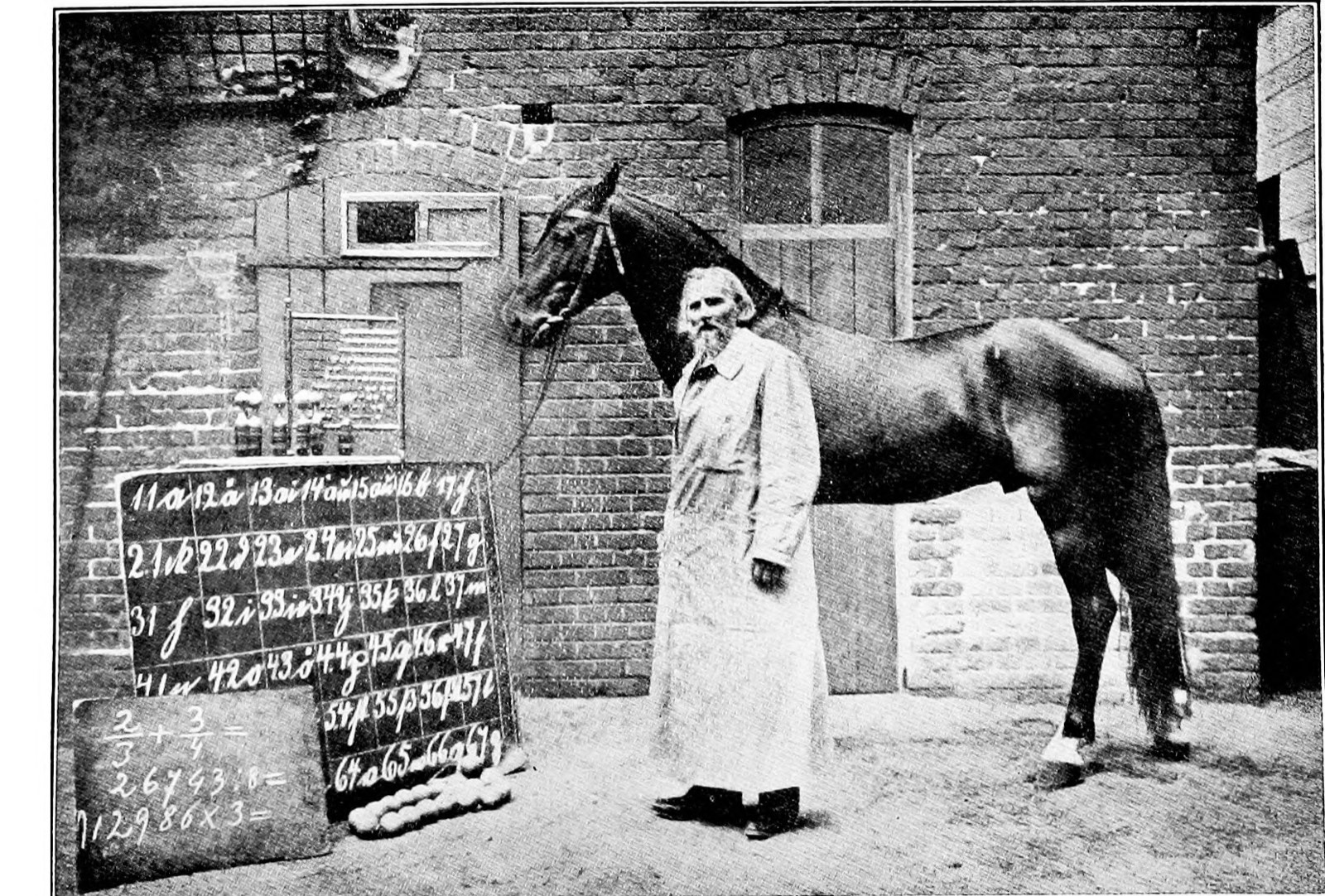
One afternoon in the autumn of 1904, inside a canvas tent pitched in a paved courtyard in the north of Berlin, a man held a card up in front of a horse so that the horse could see the number on it and nobody else could. The man was Wilhelm von Osten, the horse’s owner, and he had spent four years teaching it arithmetic. He asked the horse to tap the number. The card said 8; the horse tapped 14. The card was turned so that von Osten could see it, and he asked again, and the horse tapped 8. Another card: 4 unseen, the horse tapped 8; 4 seen, it tapped 4. Then 7 and 9, then 7 and 7; 10 and 17, then 10 and 10; 3 and 9, then 3 and 3.
The man keeping the record was Erich von Hornbostel of the University of Berlin’s Psychological Institute, and the man who had designed the test was a student of medicine and philosophy named Oskar Pfungst. Over several sittings between 13 October and 29 November they ran the card test 91 times: 49 times when the questioner did not know the answer, and 42 times when he did. With knowledge, 98 percent of the horse’s answers were right. Without it, 8 percent were.
Eight percent is about what chance gives a horse that likes the number 3 and is asked for numbers under 20. A month earlier, in the same courtyard, thirteen men who included the director of the Berlin zoo, a circus proprietor, a major-general and the professor who ran the Psychological Institute had watched the same horse and the same old man for two days of four hours each, had assigned themselves to his head, his eyes, his right hand and his left hand, and had signed a statement that “nothing in the way of movements or other forms of expression which might have served as a sign, could be discovered.” Both findings were honest. The difference between them is the subject of this entry: what it takes to test an instrument when the instrument is reading you.
Who ran it
Wilhelm von Osten was a retired teacher of mathematics from a Gymnasium, a Prussian secondary school, and the owner of a tenement house at Griebenowstrasse 10, in the working district north of the centre of Berlin, where he lived alone. He was born in 1838 or 1839, and visitors in the summer of 1904 described a man “between sixty and seventy years of age”, his white head under a black slouch hat, in a long coat several sizes too large. Carl Stumpf, who came to know him well, summed him up afterwards in one sentence: “A former instructor of mathematics in a German gymnasium, a passionate horseman and hunter, extremely patient and at the same time highly irrascible, liberal in permitting the use of the horse for days at a time and again tyrannical in the insistence upon foolish conditions, clever in his method of instruction and yet at the same time possessing not even the slightest notion of the most elementary conditions of scientific procedure,—all this, and more, goes to make up the man.”
The theory that mattered was that an animal could be taught like a child. Von Osten had tried it once already, on a horse he schooled for three years until it died, having learnt, as a later owner of Hans put it, neither to count nor to read. Then he bought Hans, a black Russian trotting stallion, an Orloff in some accounts, and from about 1900 began again. The horse never worked in harness or under saddle. It lived in a box in the back building and was taught in the courtyard every day with the apparatus of an elementary school: wooden pins, a counting frame, a chart of the numbers from 1 to 100, a child’s organ, a row of coloured cloths, and a blackboard on which the letters were set out in rows so that each could be named by two numbers, the row and the place in it. Hans answered by tapping with his right forefoot. He had never felt the whip, and was paid in bread and carrots.
By 1904 he could do, or appeared to do, everything a schoolchild could: count the people in the yard and the men in straw hats, add, subtract, multiply and divide, work with fractions, give the day of the week for any date, tell the time from a watch, name the notes played on the organ and say which note had to be taken out of a chord to make it pleasant. Shown a word, he spelled it on the letter table; told one day that “Brücke und Weg sind vom Feinde besetzt”, bridge and road are held by the enemy, he tapped out the 58 numbers of the sentence the next. Experienced educators put him at about the stage of a child of thirteen or fourteen.
Nobody paid to see any of this. Von Osten showed the horse at noon each day to whoever came, let visitors walk up to it and put their own questions. In July 1904 a retired major-general named Zobel published the first article about him, “The reading and reckoning horse”, in the Weltspiegel, the illustrated supplement of the Berliner Tageblatt. Among the readers was the African traveller and zoologist C. G. Schillings, who sent it to his friend Ludwig Heck, the director of the Berlin Zoological Garden, with a note calling it nonsense and swindle and saying they must go and clear it up. They went in the middle of July. Schillings, Stumpf wrote, “came as sceptical as anyone else, but found himself convinced when he received answers from the horse himself, devoted himself with growing enthusiasm to its demonstration, and brought new guests every day.” Within a fortnight he was working the horse alone in the yard, in von Osten’s absence, and getting answers.
That was the summer the thing became an affair. On 12 August the Prussian Minister of Education, Studt, came with his officials and stayed two hours, had the horse count his sticks and umbrellas, and, the Neue Preussische Zeitung reported, “expressed his highest admiration for the achievements of the reckoning and reading animal”. The Kaiser’s adjutant came; the Kaiser was expected daily and never came. The Tag described a street with a line of policemen down each side to keep the uninvited from the house. “Berlin in these August weeks would be a great city without entertainment, without sensation,” the Frankfurter Zeitung’s correspondent wrote on 23 August, “if the ‘learned’ horse had not taken pity on us”; the dog days, he said, had been followed by stallion days. There were couplets about Hans on the music-hall stage, postcards, a liqueur label and a toy; and on 17 August the Berliner Morgenpost began a series headed “A deception of the Berlin public”, which found the trick in von Osten’s hat and quoted a dismissed stable boy as having told his master, in the dialect of the city, that Clever Hans was really him: when he lowered his eyes the beast stamped, and when he raised them it stopped.
The man the affair fell to was Stumpf, professor at the University of Berlin, director of its Psychological Institute and a member of the Academy of Sciences, a careful man. He had looked at the horse in February and gone back in July to have von Osten explain how he taught it. With him were his assistants von Hornbostel and Pfungst, the latter a laboratory worker on the perception of the briefest visual impressions, who had, Stumpf said, the courage the job needed: Hans, excited, “would make that courtyard an unsafe place, and both Mr. Schillings and Mr. Pfungst suffered from more than one bite.”
What they were trying to find out
There were two questions, and the order in which they were asked is the whole story.
The first was the question the newspapers were asking: was there a trick? Was von Osten, or Schillings, giving the horse signals of the kind every circus trainer gives? That was the question Stumpf put to the public on 3 September in the Tag, calling for a commission whose first task “would be to judge the presence of aids in the ordinary sense of the word, and also of involuntary signs”, and to which the thirteen addressed themselves on 11 and 12 September. “Not, then, the question whether the horse thinks or not,” he wrote later, “but this precisely formulated preliminary question was first to be answered by a public declaration. The commission wanted to be a kind of court of honour for the two gentlemen under attack.”
The second question was the one everyone thought the first would answer: did the horse think? Pfungst wrote down, before the autumn experiments began, what a test of that would look like and what each outcome would mean. “By means of a very simple test it was possible to discover whether or not Hans was able to think independently. He was confronted with problems in which the procedure was without knowledge of the answer on the part of the questioner. If under these conditions he could respond with the correct answer—which could be the result of a rational process only—then the conclusion that he could think independently, was warranted. The examination would be closed and Mr. von Osten would be justified in all he claimed for the horse. If, however, Hans should fail in this test, then the conclusion that he could think was by no means warranted, but rather the inference that he was dependent upon certain stimuli received from the questioner or the environment. Further investigation would be for the purpose of discovering the nature of these stimuli.”
The design had two more parts. Trials in which the questioner did not know the answer were to be alternated with trials in which he did, so that a failure could not be put down to the horse being tired or out of sorts, a precaution earlier testers had neglected, which was why their occasional failures “could not claim objective validity, even though the persons making the tests were subjectively convinced.” And if the horse failed, the senses were to be shut off one at a time, sight first, by blinders, then hearing, smell and touch, “and finally there might be involved another still unknown sense”. Every result was to be written down at once, and “all values—including those which were not consonant with the majority—were to be used.”
So the hypothesis was two claims, as it had been at Passy in 1784 and at Nancy in 1903, and the second carried the first. The first was that the horse could count, read and reckon. The second was that its tapping reported that, and not something else. The thirteen tested the first claim by watching for the something else and not finding it. Pfungst tested it by taking the answer out of the room.
What they built
The September commission was built in a week, after Schillings announced in the Berliner Tageblatt on 2 September that since no official inquiry was coming, “we shall proceed to appoint a private commission of respected scholars and unprejudiced men”. The thirteen who signed on the 12th were Paul Busch, the circus proprietor; Count Otto zu Castell-Rüdenhausen, who had been working with the horse for weeks; Heck and his assistant Oskar Heinroth from the zoo; a school inspector, a teacher, a physician, two retired officers and a veterinarian; Nagel, the head of sense-physiology at the Physiological Institute; Stumpf; and the horseman Henry Suermondt. Who they were, what their record says they did, and what Berlin said about it are in a companion piece, “The thirteen”. The short of it is that von Osten, having insisted the tests begin without him, agreed to be watched when the veterinarian, Dr Miessner, said he had found the signal used by a rival mare called Clever Rosa at a show-house the day before: “I have neither whip nor rod, as had the man in the exhibition, and agree to any precautionary measures you may care to take.” So the commission watched him, by parts, “while Mr. Busch, since he was the most proficient in the detection of tricks, was to regard the total behavior of the man.” Every test succeeded, and Busch, alone with him afterwards, “again declared that he had noticed no trace of a sign”. The one series in two days that resembled Pfungst’s came last: Schillings gave the horse a number in von Osten’s absence and left, and von Osten came back and asked the horse to do something to a number he did not know. Five tests. “The horse nearly always repeated the number itself, instead of performing the operation required.” Schillings had, by a misunderstanding, told the horse to repeat the number for Mr von Osten, and the errors were put down to that.
The statement the thirteen signed said that tricks, “that is, intentional influence or aid, on the part of the questioner”, were “out of the question under the conditions which were maintained during this investigation”; that “unintentional signs of the kind which are at present familiar, are likewise excluded”; and that this was “a case which appears in principle to differ from any hitherto discovered, and has nothing in common with training, in the usual sense of that word, and therefore is worthy of a serious and incisive investigation.” The New York Times cabled the next morning that the horse’s feats “were performed under circumstances excluding the possibility of a trick.” Albert Moll, chairman of the Berlin Psychological Society, who had tested the horse privately in 1903, called it one of the most absurd opinions ever issued. Stumpf, when the members began to be asked for details, sent them a circular: their task had been solely to exclude tricks; they had naturally watched for involuntary influences too and seen none; they would give no account of the individual tests; “our names must vouch that they were carried out to the best of our knowledge and conscience. Whoever is not satisfied by that may go on doubting.”
He did not himself expect to find anything. “For my part I am ready to confess that at this time I did not expect to find the involuntary signals, if any such were involved, in the form of movements. I had in mind rather some sort of nasal whisper such as had been invoked by the Danish psychologist A. Lehmann, in order to explain certain cases of so-called telepathy. I could not believe that a horse could perceive movements which escaped the sharp eyes of the circus-manager.”
The second instrument was built in October. A large canvas tent went up in the courtyard, to keep the crowd out and the horse in; it was not perfect, because Hans shied whenever the wind rippled the canvas, and von Osten “repeatedly attempted to interrupt the progress of the experiments”. Von Osten and Schillings were kept out of most of the tests, and the difficulty was finding anyone else the horse would work for: about forty people had got answers from him over the summer, but “it was only when he worked with Mr. von Osten or with Mr. Schillings, that his responses were at all dependable.” Pfungst set out to befriend the horse, and “by happy chance it came to pass in a short time he responded as readily to my questions as to those of the two gentlemen.”
Eight percent
The card test opened the series and set its pattern. Words went the same way: “Hans”, “Stall” and the names of colours were written on placards and hung in a row, the questioner could see each word but not where it hung, and the horse was asked on which placard the word stood; twelve such trials gave no correct answers, and fourteen in which the questioner had first found the placard himself gave fourteen. Three words whispered in the horse’s ear to be spelled on the letter table, whose arrangement Pfungst did not know, came out wrong in every letter he did not know. Von Osten whispered a number in the horse’s ear and Pfungst whispered another, and the horse was asked to add them, so that “the sum, if known to anyone, could be known to Hans alone”: 3 right in 31. The same sums, with both men knowing the answer, 29 in 31. The calendar came apart in the same way, except for four dates that the horse’s groom, who was present, happened to know. “Hans can neither read, count nor make calculations,” Pfungst concluded. “He knows nothing of coins or cards, calendars or clocks, nor can he respond, by tapping or otherwise, to a number spoken to him but a moment before. Finally, he has not a trace of musical ability.”
Then the senses. Von Osten held that the horse heard the questioner’s “inner speech”, and had twenty tests to show that when he blocked the sound the answers went wrong. Pfungst repeated them and got right answers in the supposedly deaf condition, “a thing which greatly astonished Mr. von Osten”, and then got right answers without asking the question at all. Whatever the horse was reading, it was reading during the tapping, not during the question.
So blinders. Von Osten said the horse would not stand them and offered a slate held before the face, which failed whenever anyone but Pfungst held it; then a bolster on the horse’s cheek; then a small pair of blinders from which he had cut the straps, so that they stood out from the head and covered only the back of the field of view. Then a pair fifteen centimetres square. With those, 102 tests: the questioner certainly not seen in 35, and 6 percent correct, which was two answers; seen in 56, and 89 percent correct; undecided in 11, and 18 percent. “In other words, the horse was at a loss the moment he was prevented from seeing the questioner.” Tests with von Osten on the other side of the tent canvas failed completely; tests with the questioner in the feed-room, the door open wide enough to be seen through, all succeeded; and “toward evening the responses became less and less accurate.”
That told them the organ. It did not tell them the sign, and Pfungst found that by watching von Osten, which was hard, because the old man was never still, and then Schillings, who moved more and fidgeted less. “These signs are minimal movements of the head on the part of the experimenter. As soon as the experimenter had given a problem to the horse, he, involuntarily, bent his head and trunk slightly forward and the horse would then put the right foot forward and begin to tap, without, however, returning it each time to its original position. As soon as the desired number of taps was given, the questioner would make a slight upward jerk of the head. Thereupon the horse would immediately swing his foot in a wide circle, bringing it back to its original position.”
Pfungst set out what would have to be true if this was the mechanism: the movement must occur in von Osten in every successful trial; it must occur, with small differences, in everyone who could get answers, and be absent or mistimed in everyone who could not; suppressing it must stop the horse; and making it on purpose must drive him. All four were met. Two observers with fifth-second stopwatches, one on the man and one on the horse, timed 127 trials, with von Osten and Schillings believing the watches were timing the horse’s speed: the man moved first, and the horse followed by about a third of a second. And then the proof that mattered: “Thus, artificial synthesis became the test of the correctness of analytical observation.” If the questioner stood erect he could say what he liked and the horse did nothing. “If, however, he stooped over slightly, Hans would immediately begin to tap, whether or not he had been asked a question. It seems almost ridiculous that this should never have been noticed before, but it is easily understood, for as soon as the questioner gave the problem he bent forward—be it ever so slightly—in order to observe the horse’s foot the more closely, for the foot was the horse’s organ of speech.” Lowering the head alone sufficed: twenty-nine trials out of thirty. “If, for instance, I stooped forward after having told the horse to tap 13, and if I purposely remained in this position until I had counted 20, he would, without any hesitation, tap 20.” The farther the questioner leaned, the faster the horse tapped, which is why Hans had always seemed to hurry through big numbers; the signal carried three and a half metres and then failed, and von Osten performed most of the distance trials himself, “under the impression that we were testing the accuracy of the horse’s hearing”. Raising the head stopped the tapping; so did the eyebrows or an arm; the famous “thrust of the hand into the pocket filled with carrots” did nothing.
The head movements worked the same way. Asked “Which way is upward?” by a man standing perfectly still, Hans threw his head about at random; the moment the questioner raised his own head, Hans began to nod and went on nodding until it came down, which was his “yes”. Von Osten had always waited for that nod before a difficult question; in the trials without knowledge, “we complied; Hans nodded and—regularly disgraced himself!” One could ask Hans where his head was and have him bow to the ground, and where his legs were and have him look at the sky. The coloured cloths were a matter of posture: von Osten, standing erect, turned head and trunk towards the one he wanted, and the horse walked along his line of sight and picked the nearest, and was called back by “Look there!” when he went wrong. Asked twenty-five times in two months to fetch the green cloth, Hans succeeded six times at the first attempt.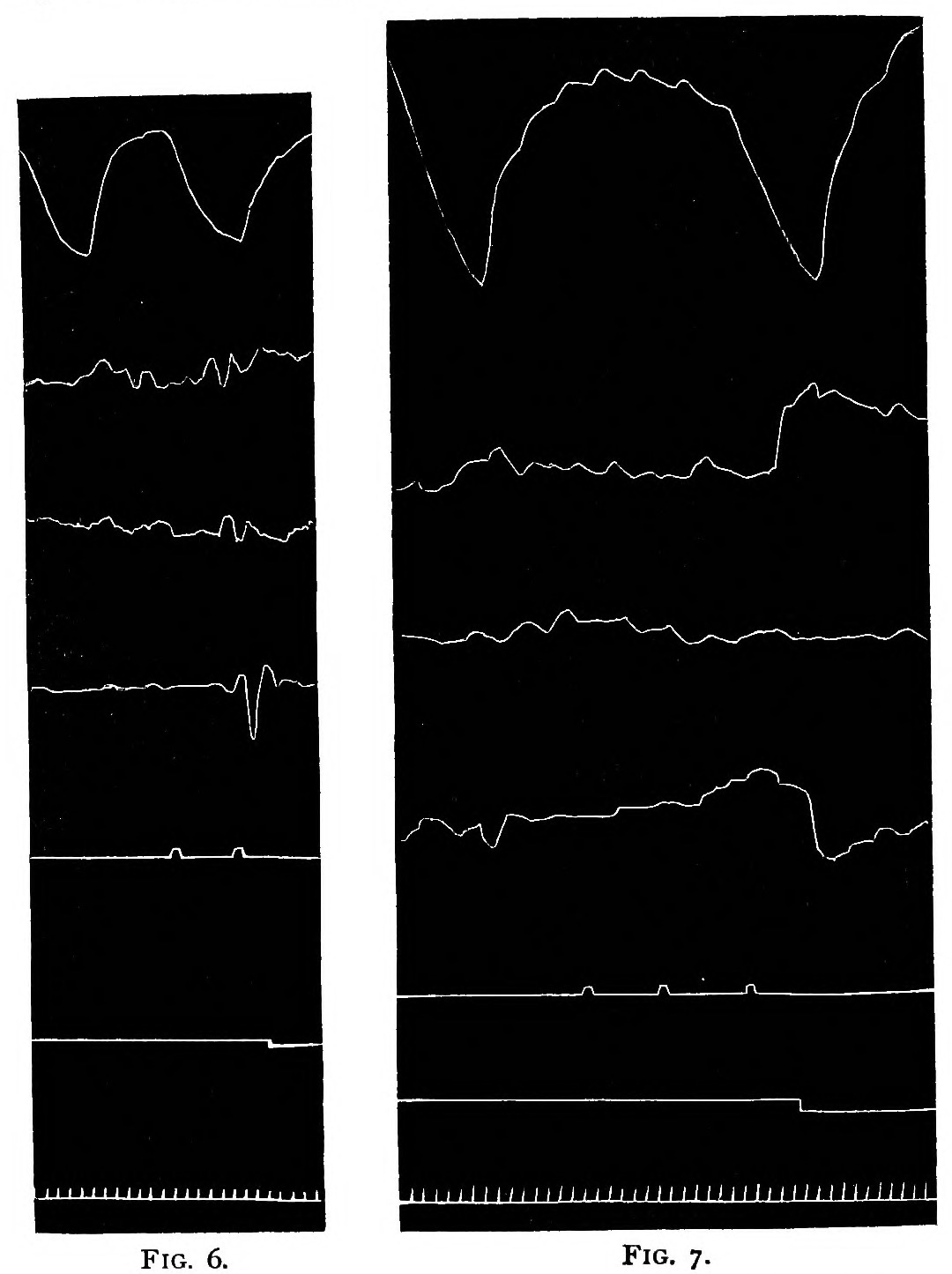
In November Pfungst took the horse’s part himself. In the laboratory he had twenty-five people of every age and sex, including children of five and six, stand on his right and think hard of a number while he tapped with his hand until he saw the sign to stop. None knew what he was looking for. All but two made the jerk. With three levers on the head writing on the smoked paper of a kymograph he measured it at about a millimetre on average, the largest 2.3 and the smallest a fifth. By that scale von Osten’s movements “could not have been more than one fifth of a millimeter”; Schillings’s were four or five times as large. The rest of the laboratory is in two companion pieces, “Twenty-five people” and “The smoked paper”.
What it looked like from inside
Pfungst’s first meeting with the horse had been in the summer, as a believer’s guest. Schillings, alone with him in the stable, asked him to think of some numbers and promised that Hans would tap them. He thought of five small ones, “somewhat skeptical in attitude”: one came out wrong, one right, and three were one too many. Over the next days, with von Osten away, the horse kept answering him, and even the errors had a system, usually a unit over. “I was able to work with the horse quite successfully, while I was still in the dark as to my own behavior.”
What it felt like from the questioner’s side he wrote down as carefully as any of the counts. The question was unnecessary; what was needed was the number, held in mind, and the moment the horse reached it. “It was easy to obtain any answer one wished to a question, simply by focussing consciousness, with a great degree of intensity, upon the answer desired. Thus Hans answered my question: ‘How many angles has a hexagon?’, first by 6, then 2, then 27, in accordance with the numbers that came into my mind. The animal always followed the ideas which were in the questioner’s mind, and never his words.” What was needed was “the determination that he should do it. An inward ‘Thou shalt’, as it were, was spoken to the horse”; in the first days the effort gave him headaches. He found his own movements last of all: “only by observing the final movement in the case of Mr. von Osten did I discover that I, too, performed a slight erection of the head.”
Von Osten watched all this and saw a horse. He knew the gross signs and talked freely about them without seeing what they were. He showed them, “You are to count to 7; I will stand erect at 5”, five times, and five times the horse stopped at 5, and called it a caprice of the animal. Asked to stop calling to the horse while it searched among the cloths, because the calls were steering it, he said: “Why that’s just what I wish to do!” Of the fine signs, the jerk of a fifth of a millimetre, he knew nothing, and Pfungst could find no way he could have learnt them. Everything the horse did wrong he had an explanation for. When it insisted that 2 times 2 was 5 it was stubborn; when it tapped 3 for everything it was bored; when it failed for a stranger it had sensed that the stranger did not know the answer and lost respect for him; when it failed in the evening it was tired. Each of these, Pfungst wrote, “was looked for in the animal which should have been sought in the man.”
The cases that had made the most converts were the ones where the horse corrected its questioner. Count Castell went into the stable alone on 8 September believing it was the 7th, asked the date, and was tapped 8. The composer Max Schillings, testing the horse’s ear, played a note a third below the one he had told von Osten he would play, and Hans tapped the note actually played, twice, before the old man’s exhortations brought him round to the wrong one. Pfungst found records of seven such cases and his own introspection explained four: the questioner’s attention had slackened, or had held the right figure under the wrong one, and the horse had tapped the figure.
Schillings, from inside, was a believer who kept running into the wall of his own belief. He had told the readers of the Berliner Lokal-Anzeiger on 11 August that the stallion “reacts to questions in an unlimited way, completely like a human being”, and on 7 September that he maintained every single word of it. For a long time he could get no answer in French, until one day, “whether accidentally or because his prejudice was temporarily overcome”, he said “Dis deux!” and the horse tapped two. He went on up to “soixante” and all came; at “soixante-six” he doubted, and Hans failed him; at “quatre-vingt” the game began again. By the autumn he had noticed something he could not explain: the horse never answered him unless he himself believed it would. By December, Stumpf reported, he had come by his own observation to the institute’s conclusion, “and when he was apprised of our conclusion in the matter, he embraced it without wavering.”
The blinders were the moment for von Osten. “When the first tests with the blinders did turn out as unmistakably sheer failures,” Stumpf wrote, “there was such genuine surprise, such tragi-comic rage directed against the horse, that we finally believed that his views in the matter would be changed beyond a doubt. ‘The gentlemen must admit,’ he said at the time, ‘that after seeing the objective success of my efforts at instruction, I was warranted in my belief in the horse’s power of independent thought.’ Nevertheless, upon the following day he was as ardent an exponent of the belief in the horse’s intelligence as he ever had been.” When Stumpf could no longer keep the results from him, he wrote a letter forbidding any further experiments. The purpose of the inquiry, he said, had been to corroborate his theories.
What happened
Stumpf published his report on 9 December 1904. It is given whole in a companion piece, “The report of 9 December”; its findings fill four sentences. “The horse failed in his responses whenever the solution of the problem that was given him was unknown to any of those present.” “Therefore he can neither count, nor read, nor solve problems in arithmetic.” “The horse failed again whenever he was prevented by means of sufficiently large blinders from seeing the persons, and especially the questioner, to whom the solution was known. He therefore required some sort of visual aid.” And: “These aids need not, however,—and this is the peculiarly interesting feature in the case—be given intentionally.” The horse “must have learned, in the course of the long period of problem-solving, to attend ever more closely, while tapping, to the slight changes in bodily posture with which the master unconsciously accompanied the steps in his own thought-processes, and to use these as closing signals.” Nobody, Stumpf wrote, had the right to charge an old man of unblemished reputation with “a most refined network of lies” when the facts could be explained another way. He ended with the sentence that is the reason the case is still taught: “If anyone has the courage to try the experiment with the dog or the ape, the insight which we have now gained will enable him to beware of one source of error which hitherto has not been noticed.”
The New York Times had it by cable the next day under the headline “Horse’s trainer exonerated”, with a sentence of its own that is worth keeping: “It need hardly be said that if this theory is accepted the achievements of Hans remain quite as extraordinary and quite as inexplicable as if the theory that the horse actually thinks is entertained.” The Berliner Tageblatt reported three days later that “Tests have been made upon Hans with blinders over his eyes and it is to be noted that, in spite of these, he still responds correctly”, which Pfungst put down to the small blinders with the straps cut off. Moll told the Psychological Society in January that Stumpf had at last come round to the view he had held since 1903; Stumpf’s answer, in his introduction to the book, was “As if there were anything like ‘confessions’ in science!” There was talk of suggestion and the occult; N-rays, which had radiated from the human brain at Nancy the year before, were proposed as the carrier.
Von Osten went on showing the horse. “The spectators continue to look on,” Stumpf wrote in 1907, “they are doubly alert to catch movements, and many of them have learned from Mr. Schillings what kind of movements they are to expect. But these ‘initiated’ ones regularly return and declare that there is nothing in the movements and that they simply could not discover any aids given to the horse.” Von Osten withdrew the horse in December, so that some series were never finished. Pfungst’s book, with Stumpf’s introduction and the two reports as supplements, came out in Leipzig in March 1907. Von Osten was sent a copy by the author. On 23 March he handed it, uncut, to a visitor, and said he did not want it.
After
The visitor was Karl Krall, a jeweller from Elberfeld who had not believed Pfungst and in the summer of 1905 had persuaded the old man to let him experiment. He went on at intervals until 1908, five months in all by his count and more than 12,000 trials, with a single large blinder on the questioner’s side, the questioner six or eight metres off, and sometimes in the dark, and concluded that the horse “works with the blinder as reliably as without, and in the dark as well as by day”, and that the only explanation that fitted every fact was “the assumption of an independent thinking activity on the part of the horse.” Hans never left the courtyard from June 1904 to July 1909; Krall found no groom there in his time and a stall that went months uncleaned.
Von Osten was bedridden from January 1909 with cancer of the liver and died at about three in the afternoon on 29 June, in his seventy-first year, “lonely and embittered, but in the firm conviction that the hour of recognition would strike for him and his life’s work too.” Krall had gone to his bedside in May. “His last word to me was a curse on his Hans, whom he blamed for the bitter misfortune of his own life. His lasting deep hatred of his horse, for which he wished ‘an end before the mortar-cart’, endured to the last.” He was buried on 3 July at the Zionskirchhof, and the superintendent who preached spoke of a lonely, unworldly recluse, “the vainly struggling, the self-deceived, the supposed ‘researcher and discoverer’”. The Berlin papers gave him a paragraph each; the Morgenpost heard that his will required the horse to be shot, the Lokal-Anzeiger that it was to be kept until the end of its life. On 5 July, by an arrangement von Osten had made, Hans was walked to the Lehrter station “amid the lively sympathy of the neighbourhood” and sent by rail to Krall. He behaved, Krall noted with relief, quite calmly.
Krall’s book, Denkende Tiere, “Thinking Animals”, came out in 1912, with Hans in it beside two Arab stallions, Muhamed and Zarif, that Krall had bought and taught, he said, in months, and the whole argument began again with Krall’s horses in the place of von Osten’s. Edmund Sanford, reviewing it for the American Journal of Psychology in 1914, noted that in Krall’s dark experiments there was light enough to see unlit matches by, and that the time Krall had allowed for the horse to get used to the blinder might have been the time it took to learn a new sign in place of the one cut off. Pfungst’s book was translated into English in 1911 by Carl Rahn of Chicago, and reissued in New York in 1965 with an introduction by Robert Rosenthal. Von Osten never read it, and Fedor Freund, who had printed 4,000 copies of his own pamphlet proving the horse a mere calculating machine, told the Morgenpost in 1909 that he had sold thirty-two.
What it taught
Stumpf’s thirteen were not fools, and they were not wrong about what they tested. They watched a man for a signal, assigned a pair of eyes to each of his limbs, put the one professional in the room alone with him, and saw nothing. What they missed was that their method could only find a signal of a kind someone in the room already knew how to see, and their statement said as much, in a clause the public skipped: “unintentional signs of the kind which are at present familiar”. A null result from an observer is bounded by what the observer can observe. It says nothing about a fifth of a millimetre.
Blind the questioner, not just the subject. The commissioners of 1784 bandaged a boy’s eyes; Pfungst’s blinders did the same for the horse. But his decisive test was the other one, the card turned away from the man asking, which everyone had taken for a test of the horse’s reading. It was a test of the questioner. The answer in the horse’s hoof was only ever as good as the answer in the questioner’s head, and when the head was empty the hoof was empty, 8 percent against 98. Every later experiment in which the person who records the result does not know which result is expected descends from that card.
The instrument was reading the experimenter. Everyone in the yard, including the sceptics, took the horse for the thing under test and the man for the operator. The reverse was true. The horse was a detector of about a millimetre’s movement at three and a half metres, with a reaction time of a third of a second, and the quantity it detected was the questioner’s expectation. That is why it corrected Castell’s date, why it mirrored a miscalculation, why it answered the composer’s note rather than the note the old man had been told of, and why it could be made to find a hexagon’s angles to be 6, 2 and 27 in turn. A result that tracks the experimenter’s mind more faithfully than the facts is the signature of this fault.
A theory that explains its failures cannot be tested by its failures. Stubbornness, boredom, fatigue, the dark, the horse’s loss of respect for a questioner who did not know the answer: each was true as a description and each sealed the result against the one test that would have broken it. When the trials without knowledge failed, von Osten said the horse had sensed the ignorance; when the big blinders failed, he raged at the horse. The commission at Nancy explained Wood’s failure to see the rays by his eyes. The form is the same, and so is the remedy: before the test, write down what its failure will mean, as Pfungst did.
Observation is confirmed by synthesis. Pfungst did not rest on having seen the jerk. He listed the four things that would have to be true if the jerk was the cause, and then he made it on purpose and got every one of the horse’s tricks at will, 20 for 13, a nod, a shake, a bow to the ground, and he stood still and got nothing. Analysis that cannot be followed by control is a suspicion. The thirteen had only looked.
The complication is that the finding changed nothing it was supposed to change, and the result that lasted was not about the horse. Von Osten exhibited Hans for four more years to people who had been told what to watch for and could not see it; Krall ran 12,000 trials and reached the opposite conclusion; and the owner died cursing the animal rather than doubting himself. What outlived all of them was a sentence in Stumpf’s report about dogs and apes and “one source of error which hitherto has not been noticed”, and the twenty-three people out of twenty-five in the laboratory who, thinking hard of a number, raised their heads a millimetre at the moment they reached it and did not know they had. Hans was one horse. The questioners were everybody.
Sources
- Oskar Pfungst, Clever Hans (The Horse of Mr. von Osten): A Contribution to Experimental Animal and Human Psychology, translated by Carl L. Rahn, with an introduction by Carl Stumpf and a prefatory note by James R. Angell, New York: Henry Holt, 1911. The source of every quotation from Pfungst and Stumpf in this entry unless another is given: the courtyard and the horse’s repertoire (chapter I), the design, the tests without knowledge, the blinders, the head-jerk, the stopwatch timings, the synthesis, the head movements and the cloths (chapter II), the introspections (chapter III), the laboratory records and the one fifth of a millimetre (chapter IV), the errors, the seven cases, the composer and the French (chapter V), von Osten’s character and the gross signs (chapter VI); Stumpf’s introduction (the nasal whisper, the blinders and the “tragi-comic rage”, the letter forbidding further tests, the “confessions”, the initiated spectators); Supplement I (the method of instruction); Supplement II (the statement of 12 September 1904 and its thirteen signatures); Supplement III (Stumpf’s abstract of the commission’s records); and Supplement IV (the report of 9 December 1904). The frontispiece is the first figure and page 126 the second. Cornell University Library copy. archive.org
- Oskar Pfungst, Das Pferd des Herrn von Osten (Der kluge Hans): Ein Beitrag zur experimentellen Tier- und Menschen-Psychologie, with an introduction by C. Stumpf, Leipzig: Johann Ambrosius Barth, 1907. The German original, used to check the English against the text, and for Stumpf’s account of Schillings’s first visit in mid-July, translated here by the author of this entry. archive.org
- Karl Krall, Denkende Tiere: Beiträge zur Tierseelenkunde auf Grund eigener Versuche. Der kluge Hans und meine Pferde Muhamed und Zarif, Leipzig: Friedrich Engelmann, 1912. The chronology “Die Geschichte vom Klugen Hans” (pages 279 to 350), which reprints by date the Berlin and provincial newspapers of 1904 and 1909: Zobel’s article of 7 July, the minister’s visit of 12 August as the Neue Preussische Zeitung reported it, the Tag of 12 August, the Frankfurter Zeitung of 23 August (“Berlin, du glaubst es?”), the Berliner Morgenpost of 17 August and the stable boy, Schillings’s articles of 11 August and 7 September and his announcement of 2 September, Stumpf’s article in the Tag of 3 September and his circular of 15 September, Moll’s statements of 20 October 1904 and 5 January 1905, the German text of both reports, the horse’s conditions in the yard from June 1904 to July 1909, von Osten’s illness, death on 29 June 1909, last words and burial, the newspapers of 30 June to 2 July 1909 on the will, the horse’s journey on 5 and 6 July, Krall’s own 12,000 trials and conclusions, the uncut book, and Freund’s thirty-two copies. All translated here by the author of this entry. archive.org
- The New York Times, 4 September 1904, magazine section, “Berlin’s Wonderful Horse: He Can Do Almost Everything but Talk—How He Was Taught”, by Edward T. Heyn, dated Berlin, 23 August: the retired teacher and his tenement house, the four years of instruction, the counting machine and the carrots, the horse’s age, the performance before the Duke of Saxe-Coburg-Gotha, and the Kaiser who was to have seen the animal by the time the article was in print. archive.org
- The New York Times, 14 September 1904, “Hans an Equine Wonder: German Scientific Commission Examines the Educated Horse”, a cable from Berlin of 13 September: “excluding the possibility of a trick”. archive.org
- The New York Times, 11 December 1904, “Prof. Stumpf’s Report on von Osten’s Wonderful Animal: Horse’s Trainer Exonerated”, a cable from Berlin of 10 December with an Associated Press dispatch: “quite as extraordinary and quite as inexplicable”, and the blinders. archive.org
- New-York Tribune, 14 August 1904, page 1, “A Highly Accomplished Horse”, from Berlin, 13 August: the Orloff stallion, those who had tested him, Studt’s remark about the wizard, and von Osten’s wish for a commission of specialists for four weeks. Library of Congress, Chronicling America, read through its full-text service. loc.gov
- The San Francisco Call, 24 September 1904, page 8, “Hans, the Wonderful Thinking Horse and His Master, Herr von Osten”, from Berlin, 2 September: the portrait of von Osten as “a quaint, old, withered, long-haired little man with the looks of a professor and the garb of a mendicant”, the slouch hat and the oversized coat, and the refusal to charge admission. Library of Congress, Chronicling America. loc.gov
- The Washington Times, 13 November 1904, page 24, “Clever Hans”: Moll’s address to the Psychological Society of Berlin and his unanswered letter. Library of Congress, Chronicling America. loc.gov
- Edmund C. Sanford, “Psychic Research in the Animal Field: Der Kluge Hans and the Elberfeld Horses”, American Journal of Psychology, vol. 25 no. 1, January 1914, pages 1 to 31. The horse’s age as eight, Krall’s arrival in 1905, his blinder and dark experiments and the objections to them, the Arab stallions, and the reopening of the controversy. archive.org
- Oskar Pfungst, Clever Hans, the Horse of Mr. Von Osten, edited by Robert Rosenthal, New York: Holt, Rinehart and Winston, 1965: the reissue of the Rahn translation with Rosenthal’s introduction, in copyright and cited only for its existence. archive.org
- The companion pieces: “The thirteen”, on the September commission, its records and its statement; “The report of 9 December”, Stumpf’s report in full; “Twenty-five people”, on the laboratory experiments with human questioners; and “The smoked paper”, on the kymograph records and the sheets of paper on the floor.
How this entry came about
Written in one night of the overnight run of 21 October 2026, from the backlog line that named Pfungst's book. The whole of the 1911 English edition was read from the Cornell scan on archive.org, and the German edition of 1907 and Krall's book of 1912 were read in the parts cited; quotations from the English edition are Rahn's translation of 1911, which is public domain, and every quotation from a German newspaper of 1904 or 1909 is taken at second hand as Krall reprints it in his chronology and translated by the writer, since the Berlin papers themselves could not be reached: the Deutsches Zeitungsportal refused the connection from this machine, and the writer did not try to work round the refusal. The Library of Congress pages were read through loc.gov's JSON and full-text service after its viewer answered 403. Stumpf's account of Schillings's first visit is translated from the German edition because the corresponding passage of the English introduction was not consulted in the scan.
Numbers that differ between sources: the horse's age (nine in the New York Times and the Tribune, eight in Sanford); its breed (a Russian trotting horse in Pfungst, an Orloff in the American papers, a black stallion in Krall); von Osten's age (born 1838 or 1839 by Krall's "seventy-first year" at his death, "between sixty and seventy" in Pfungst); the number of people who got answers from the horse (about forty, Pfungst); the number of Krall's trials (more than 12,000, his own count). The sums the commission's record gives as "5, 8 and 3" and "16" are given by the newspapers of the time as "5, 3 and 2", "11" and "10", as Pfungst notes. The one fifth of a millimetre was read from the page image because the OCR lost the fraction.
Decisions under the overnight rules: two figures, both from the 1911 edition, a publication before 1930 (rule 1); the frontispiece is printed sideways in the book and has been turned upright, and the kymograph figure is cropped from page 126 at the scan's own 1,080 pixels rather than enlarged; the halftone of Hans and von Osten printed in the New York Times of 4 September 1904 and the one in the San Francisco Call of 24 September were left out because the first is under 700 pixels wide at the scan's native resolution and the second's image service could not be reached (rule 1). A first draft of 8,460 words was cut to the house length, and the September commission's records, the December report and Pfungst's laboratory experiments were moved into four companion pieces, each kept under the checker's 3,000 words (rule 2). The date hour was set at the push by rule 4 and is recorded in the run log. Title "Eight Percent", the figure from the card test, not used before (rule 5). No pull request (rule 6). Checker and narration notes are in the run log.