The previous piece gave the laboratory experiments in which Pfungst played the horse and read numbers and concepts off his questioners’ heads. This one gives the part of Chapter IV in which he stopped relying on his own eyes and had the movements write themselves down, and the experiment that stood in for the coloured cloths. The quotations are from Carl Rahn’s English of 1911; the fractions of a millimetre, which the scan’s text layer lost, were read from the page images.
The apparatus
Pfungst was not content with having seen the jerk. He borrowed the device the psychiatrist R. Sommer had built to record the tremor of a hand in three dimensions, three levers each writing on the smoked paper of a revolving drum, and fitted it to the head. “The subject whose movements were to be registered, was placed in the device in such a way that his trunk and head were bent slightly forward, the latter a little more than the former. This, it will be remembered, was the usual position of the questioner when working with the horse.” One lever took movements forward and back, one right and left, one up and down; “micrometric determination showed that when the subject was properly installed, movements through so small a distance as one fifth of a millimeter could be accurately ascertained.” A pneumograph on the chest wrote the breathing on the same drum. Nobody else was in the room, and the subject never saw the curves.
“The subject was now told to think of some number, which, of course, was unknown to me. At a given moment I was to tap upon one of a series of keys arranged like those of a piano, with the middle finger of my right hand—corresponding to the right forefoot of the horse. The questioner observed my key, I, his head,—just what had happened in the experiments with Hans.—and as soon as I perceived the involuntary closing signal I reacted upon it by releasing, suddenly, another key upon the same keyboard, which I had in the meantime been pressing down with my second finger, thus marking what with Hans had been called the backstep.” Electromagnets wrote both keys on the paper, and a chronograph wrote fifth-seconds under them. A Hering kymograph on felt carried the paper; the levers wrote tangentially, with their points in one vertical line, so that what happened at one instant stood in one column.
The questioners were Schillings and three students of philosophy, von Allesch, Chaym and von Manteuffel. Von Allesch and Chaym knew nothing of what was being watched, kept their heads bowed, and “did not perceive what it was that I was observing”; Chaym, on his only visit to the horse, had got a number of correct answers at once. Schillings and von Manteuffel knew something of the movements, and it hurt them: “afraid lest their knowledge vitiate the result, lost more and more of their power of concentration and within a short time were in a condition of tense inhibition”, so that Pfungst’s successes with von Manteuffel fell from 73 percent in ninety trials to 20 percent in twenty, and with Schillings from “75-100% to 23% in a series of 35 tests.” Knowing was worse than not knowing. Pfungst’s own movements, he noted, were as pronounced as ever, and he found them as hard to suppress in the laboratory as he had in the courtyard.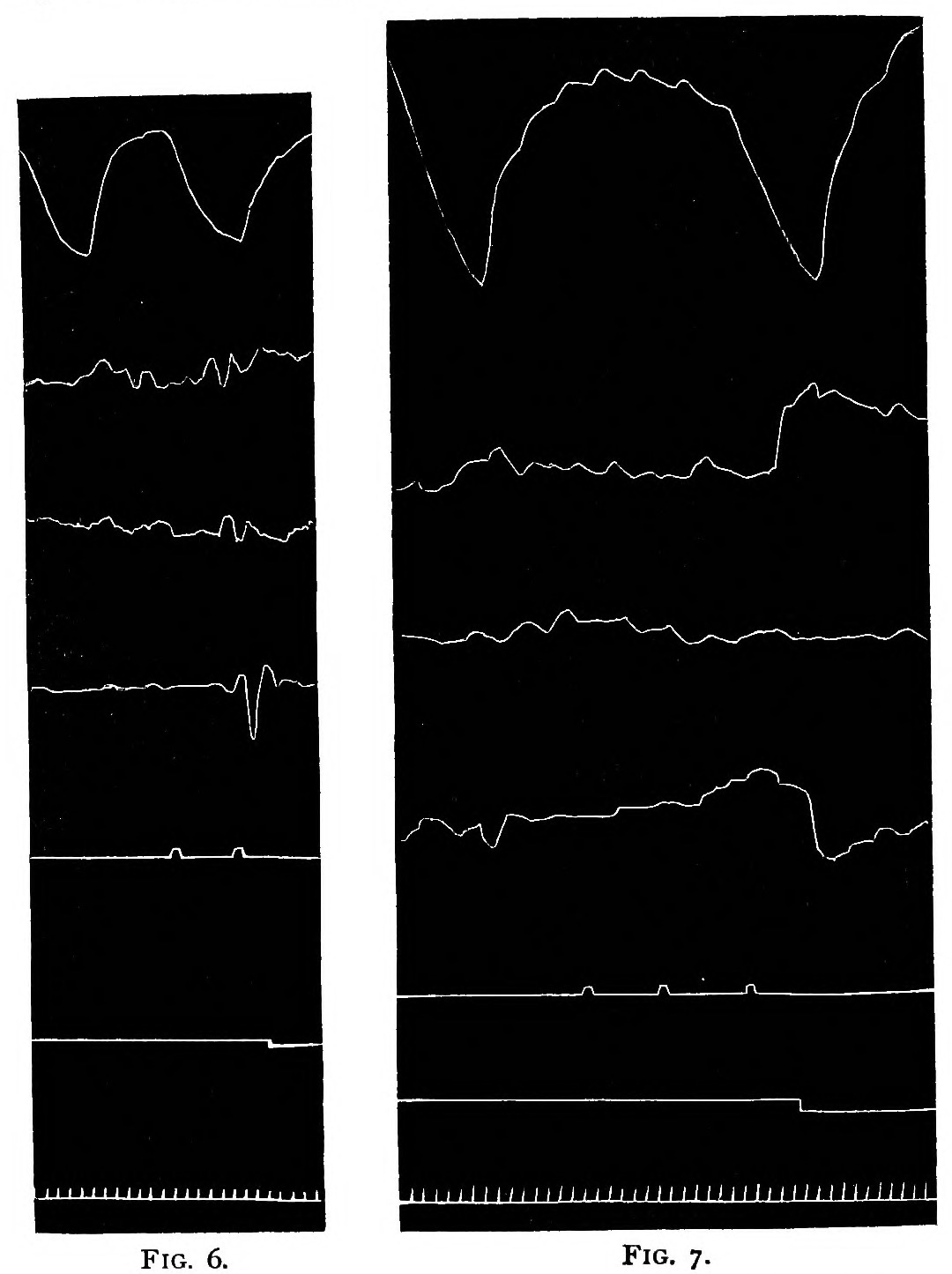
What the curves showed
Seven records were published, “which show the great general uniformity of the tests made upon the horse with those made in the laboratory”. In each the breathing stopped or went shallow during the trial and a deep breath followed it; “in ordinary life we often notice that highly concentrated attention is usually accompanied by non-voluntary inhibition of movements in the musculature which, for the moment, is not directly involved; the man lost in thought slackens his pace and finally stands still, the intent listener or looker-on holds his breath.” The two upper tracings of the head showed only “the ordinary tremor-like movements” and the fact “that the subject is unable to hold his head absolutely quiet for even one second”. In the third “the oft-mentioned head-jerk (which indicates arrival—in the counting—at the number expected) registers itself”, almost always at the moment of the first deep breath after the trial, but not caused by it, since it came when the subject held his breath too.
“The actual height of the jerks recorded in figures 6 to 12 was from a quarter to one and a quarter millimeters and the average height obtained from the forty curves of these four subjects was 1 millimeter. There is great individual variation: the greatest height that was obtained from the records was 2.3 millimeters, the lowest one fifth of a millimeter.” Von Allesch’s seventy-five trials averaged a millimetre with a mean variation of a fifth. Against this scale Pfungst set the old man: his movements “were more minute than almost any of those of which we obtained records. At the most they could not have been more than one fifth of a millimeter”, though the brim of his hat made them look half as large again; Schillings’s “were certainly four or five times as great as those of Mr. von Osten, and occasionally even greater than that.” In a special series a subject was asked to make head movements as small and even as he could, and Pfungst judged them against the record: “my judgments were most exact in the case of the most minute jerks.” What had made von Osten so easy to read, once one knew what to look for, was “their extraordinary evenness, such as I have not met with in any other individual.” The interval from the jerk to Pfungst’s release of the key averaged three tenths of a second, “a value which agrees very favorably with that estimated for the horse”, so that “man and beast have the same reaction-time”.
Figure 6, von Allesch thinking of 2, shows “the great, and at the same time economic concentration of attention characteristic of the subject”, breathing little changed and the jerk “just at the proper moment”. Figure 7, Chaym thinking of 3, shows a breath held throughout, the head sinking as the tension rose, and a jerk mostly backward and only a fraction of a millimetre up; it was this decided raising of the head after the jerk “that prevented the usual back-step with the left foot, when the subject was working with Hans.” Figure 8, von Manteuffel, shows a sudden forward bend before the last number and “a violent jerk of the head, upward”. The three records of Schillings, all with 4 in mind, show a tension that “exploded, as it were, too soon” at 3; a normal one; and one so slack that no final jerk came and the head rose steadily from the first tap, “but it is hardly probable that Hans would have reacted properly upon these stimuli.” Had he been working with the horse, Pfungst wrote, the first record would have given three taps of the right foot and one of the left, the second four taps, and the third a horse that tapped on past 4. Three records of “up” and “yes”, figures 13 to 15, show a slight rise of the head for the one and a lowering and raising, a nod a millimetre or two high, for the other.
Five sheets of paper
For the coloured cloths there was a floor. “Five sheets of white paper, three quarters of a meter long and half a meter wide, were arranged in a series upon the floor, a quarter meter apart. A dot marked the middle of each. The experimenter stood at a distance of seven and a half meters and directly opposite the middle sheet. At about a quarter meter to the right or left of him stood the subject who took the part of the ‘horse’. The problem of the experimenter was to indicate to the ‘horse’ a certain one of the five sheets, but without the use of word or gesture.” Pfungst played the horse first. “All of them looked fixedly at the sheet which they had in mind. Besides, it usually happened that they would turn at least their heads, and often their bodies, more or less in the direction of the particular sheet—and this without purpose or knowledge on their part, but purely as a result of concentration upon the sheet they wished me to point out.” One experimenter noticed that Pfungst did better the harder he thought of the sheet; others admitted, after a miss, that they had been wavering towards the neighbour he had chosen. In 200 trials with each of six questioners he scored 88, 88, 77, 81, 77 and 82 percent, an average of 82, and every error was to the sheet next door. When the roles were reversed the six subjects scored 76, 79, 75, 81, 77 and 74, an average of 77. The horse, under similar conditions and without the calls that steered him, had managed about a third, and had strayed further when he strayed.
With one subject, a student of philosophy named Koffka, Pfungst took the test to its limit. Ten sheets instead of five made little difference. Then the sheets were replaced by ever narrower strips of white paper on dark card under a Nernst lamp, closer and closer together: from 50 centimetres between centres, at which the body turned about three and a third degrees from one to the next, to 13 centimetres, correct inferences fell only from 77 to 61 percent. And then Koffka, straining, began without knowing it to make “a new system of expressive movements of the head”, exaggerated head turns compensated by an eye movement the other way, which were easier to read than the eyes alone, so that at an angle of one degree Pfungst’s score rose from 60 to 80 percent and stayed near 80 as the strips closed to 20, 13, 6 and 4 millimetres apart. At two millimetres between centres, one minute of arc, “the subject was unable to focus, with sufficient steadiness of vision, upon one paper alone, and the movements, for that reason, ceased to manifest themselves.” Two other subjects, whose reactions stayed normal, gave 53 percent at five minutes of arc. In another series of 200 trials Miss St. “merely thought of the places”, and Pfungst scored 56 percent; “Miss St. believed this a case of true telepathy, but I had been guided in my judgments entirely by her unwittingly made movements—or rather the direction—of her eyes.”
What Pfungst made of it
Hans, he concluded, had been reading what the stage mind-readers read. “The productions of mind-readers, so-called, also, are based upon the perception of involuntary movements, insofar as they are not based upon pre-arranged schemes and trickery. But there we have to do principally with tactual perception, since the reader touches the hand of the subject and is guided by its tremor.” Some worked without touch, by the sound of footsteps, by involuntary whispering, by the breathing, by posture and the movements of eyes and lips, “and my own experience has taught me that surprising results may be obtained by the utilization of the movements described in the preceding chapter.” He thought the same “truly microscopic movements” might lie behind some of the experiments in telepathy: “In spite of the huge mass of ‘experimental evidence’ which has been collected, chiefly in England and in America, it appears to me that telepathy is nothing but an unproven hypothesis based upon experimental errors.”
He was careful about the word everyone used. The writers all spoke of unconscious movements. “My own introspections, however, have led me to doubt whether they are quite unconscious. Since I have attained some practice I am able to describe in detail (under conditions of objective control) my involuntary movements, no matter how slight, even down to mere muscular tensions. None of my subjects, however, has as yet succeeded in this.” It was hard, he said, to watch for an unknown movement while concentrating on a number, “for this very dividing of attention effects a decrease in the force of the movement, and thus makes it all the more difficult to discover.” The movements, he suggested, “are not unconscious, but merely unattended to”, and he chose his words throughout the book so as to leave the finer question open.
And he went back a century for company. Count Agénor de Gasparin, who had published a careful record of table-turning in the 1850s and had put the movements down to a fluid, had set down every rule Pfungst found in the courtyard: that some operators are better than others, that an indisposed operator fails, that the table must be got “en train” and then not interrupted, that “if the will is absent, nothing moves”, that too little will makes the table rap on past the number and too much makes it fail, that the number need not be spoken but only thought, that large numbers are rapped faster than small, that tests in which nobody knows the answer fail, and that when two operators want different numbers the stronger wins. Faraday had shown in 1853 that the table was moved by the sitters’ hands, and the sitters had answered that his subjects were not real spiritualists. Pfungst put the two cases side by side and said they were identical in kind, with one difference: the table was dead wood, and Hans was alive, so that the movement reached him as a sight and not as a push.
Sources
- Oskar Pfungst, Clever Hans (The Horse of Mr. von Osten), translated by Carl L. Rahn, New York: Henry Holt, 1911, chapter IV, “Laboratory Tests”, pages 116 to 140, with figures 5 to 15; chapter IV’s footnote on mind-readers and telepathy, page 108; chapter V, pages 203 to 211, with the footnote on de Gasparin and the remark on Faraday. Every quotation in this piece is from that translation. The second figure of the entry is page 126. archive.org