The entry leaves the Bear in 1932, sold to Admiral Byrd for $1,050, and finds her again on the seabed. She had thirty-one more years afloat and fifty-eight under water, and most of what happened in them is on record, in her logbooks, in a trade paper, and in the report of the team that identified her. This is that record, in order.
Oakland, 1926 to 1932
The Bear went north for the last time in 1926. It was her thirty-fourth voyage to Alaskan and Arctic waters since 1885. When she came back to Oakland in November a new cutter, the Northland, took her station, and the city asked for her. In 1927 President Coolidge signed her over to Oakland as a museum ship, and on 3 May 1929 the Coast Guard decommissioned her. She was fifty-five years old. Alexander Stephen and Sons had built her at Dundee in 1874 for the Newfoundland seal hunt: 198 feet overall, oak ribs fourteen inches square set five or six inches apart at the bow, two layers of oak planking and an outer skin of Australian ironbark, six to eight inches of wood in all, fastened with Swedish iron bolts, and a 300-horsepower compound steam engine that had never been changed.
In 1930 she went to work for a film company. In that year’s film of Jack London’s The Sea Wolf she played the Macedonia, the sealing steamer of the story; the Bear had spent forty years chasing sealers off the Pribilofs.
Bear of Oakland, 1932 to 1935
In 1932 Richard Byrd bought her for $1,050. He was fitting out his second Antarctic expedition and needed an ice ship to replace the City of New York, the barquentine of his first, and he renamed her Bear of Oakland. In September 1933 she was in drydock at the East Boston shipyard for repair and refit. A photograph in the Leslie Jones collection at the Boston Public Library shows workmen at her stern fitting a new propeller, with the propeller post behind them and its rows of bolt heads in plain view. Nobody would look at the bolts for eighty-eight years.
She left Boston on 25 September 1933 under Lieutenant Robert English, bound for Dunedin in New Zealand and the Ross Sea, in company with a steel lumber carrier Byrd had renamed Jacob Ruppert for the brewer who paid for much of the expedition. She still ran on coal and canvas, with the engine of 1874 in her. She spent the southern winter of 1934 laid up at Dunedin, went back to the ice to bring the expedition out, and was home in 1935.
One of the fifty-six men of the expedition was a cook on the Bear of Oakland named Joseph Hill Jr. He was born in Canyon, Texas, in 1913, and was an Eagle Scout. He had written to Byrd without telling his parents, offering to go in any capacity, and about a year later Byrd’s personnel manager invited him to Boston for an interview. He had no money for the train, so he hitch-hiked from Texas to Boston. He passed the interview and the physical and was put on the roster as a cook. He was twenty, the youngest man in the expedition, and was called Joe Boy. He went south as second cook on the Bear of Oakland, was made Byrd’s personal orderly, and in Antarctica drove tractors, worked as a mechanic, unloaded the ships, helped build Little America II on the Ross Ice Shelf and helped build Advance Base, the hut 123 miles south of it where Byrd spent the winter of 1934 alone, poisoned by the fumes of his stove and generator, until a tractor party reached him in August. Hill wrote pieces for the expedition’s magazine, the Barrier Bull. In 1937 a book came out under his name, In Little America with Byrd, written for young readers from the experiences of the fifty-six, and dedicated to Byrd.
He took a degree in mechanical engineering at the University of Texas, worked for Douglas Aircraft, and became chief engineer of the Janitrol Aero division in Columbus, Ohio. In 1998 he was interviewed for the documentary Alone on the Ice and said he felt “a great deal of pride” about the expedition and would do it again. He died on 15 October 1999. His family gave his papers to the Byrd Polar archives at Ohio State on 17 July 2000.
After the expedition Byrd leased the ship to the Navy for one dollar a year.
USS Bear, 1939 to 1944
In 1939 President Roosevelt put Byrd in charge of a United States Antarctic Service, and the Navy took the ship back. On 11 September 1939 she was commissioned USS Bear, AG-29, under Lieutenant Commander Richard H. Cruzen. The coal-fired engine of 1874 came out. Her log for 9 October 1939 records the new diesel going in and steel sheeting in the engine room; the tall funnel went with the boilers, and the rig was cut down so that she could carry a Barkley-Grow seaplane. She sailed from Boston on 22 November 1939, loaded forty-five tons of zinc ballast in pigs in Virginia on 25 November, and was back on 5 June 1940. Her second voyage ran from 10 October 1940 to 18 May 1941; on 16 March 1941 she reached the Mikkelsen Islands, where her crew helped build an airstrip to fly out the men and equipment of the base there as the government closed the service down.
Her third commission was the one she had begun with: Greenland, where the Navy had first sent her in 1884 to look for Greely. In 1941 her masts were cut down to two and fitted for radio, guns were put aboard, and she was given a Coast Guard crew. She joined the Northeast Greenland Patrol under Edward Smith with the Northland, the cutter that had replaced her at Oakland in 1926.
On 12 September 1941 the Northland, alerted by a Danish observer at the weather station on Ella Island, found the Norwegian sealer Buskø on the East Greenland coast, carrying supplies and relief men for Norwegian hunting and weather stations under a permit from the Quisling government, with twenty-six men and one woman aboard, and seized her. A landing party found a radio operator the Germans had put ashore, Jacob Bradley, in a hunting cabin, took him, and destroyed his set. The Bear towed the Buskø to Boston. They arrived on 14 October 1941, and the New York Times had already reported a Nazi spy ship with a Gestapo agent caught in the Western Hemisphere. The Navy’s administrative history called it “the first blow struck by the United States Navy against Germany”, and the capture is still described as the first American naval capture of the war. It is disputed. The United States was not at war, Norway was not an enemy, and the crew were charged with entering the country without papers rather than held as prisoners; all but Bradley were released. The Buskø went back to Norway and sank in 1952 with twenty men.
She came back to Boston from the patrol on 15 November 1943. On 8 May 1944 her log records the removal of the engine and reduction gear; on 17 May 1944 she was decommissioned, and she lay in Boston, with no engine, until the Maritime Commission took her on 13 February 1948.
Arctic Bear, 1948 to 1962
In 1948 Frank M. Shaw of Halifax bought her for $5,199 and renamed her Arctic Bear. He meant to send her sealing, the trade she was built for. His company bought a replacement engine, found the forty-five tons of zinc in her bilges and sold it to pay for the work, and never installed the engine: the Newfoundland hunt was shrinking and the refit cost more than the ship would earn. She was laid up at moorings around Halifax and Dartmouth, refitted a little at a time, and left for long stretches. In the early 1960s Dartmouth, Oakland and the marine museum at San Francisco each looked at her as a museum ship and each gave up on the price and the cost of restoration. The Halifax Chronicle-Herald of 19 April 1962 reported the last of those plans scuttled.
In 1962 Alfred M. Johnston, who owned restaurants in Philadelphia, bought her for a floating seafood restaurant and museum on the Philadelphia waterfront. She was repaired at Industrial Shipping Limited at Mahone Bay, Nova Scotia, and a new bear was carved for her bow. Johnston insured her for $150,000 and expected a million dollars a year of business from her, with $50,000 of it profit.
17 to 19 March 1963
She left Halifax on 17 March 1963, St Patrick’s Day, behind the seagoing tug Irving Birch, Captain W. C. Chisholm, bound for Philadelphia. Two caretakers were aboard her, Percy Coffin and Henry Dingle, both of Dartmouth. She had no engine and no ballast, and she rode high.
A gale came up. Early on 19 March, about a hundred miles south of Shelburne, Nova Scotia, the tow line parted. The foremast broke in two and came down, and the hull was holed; she went down by the head and listed to starboard, with the main and mizzen masts working loose. A Coast Guard aircraft from Boston dropped a rubber dinghy. Coffin and Dingle got into it and the tug picked them up. At dusk Chisholm, speaking by radio-telephone to Ed Walters of the Canadian Press in Halifax, said he could just make out her riding light; he was standing by for the seas to go down so that he could get another line aboard in the morning. She sank some time after 9:10 that night. When the search began at dawn on 20 March there was nothing on the surface. The accounts differ on the hour: the Coast Guard’s historian gives 9:10 in the morning, and the trade paper that printed Chisholm’s radio traffic within weeks gives the night.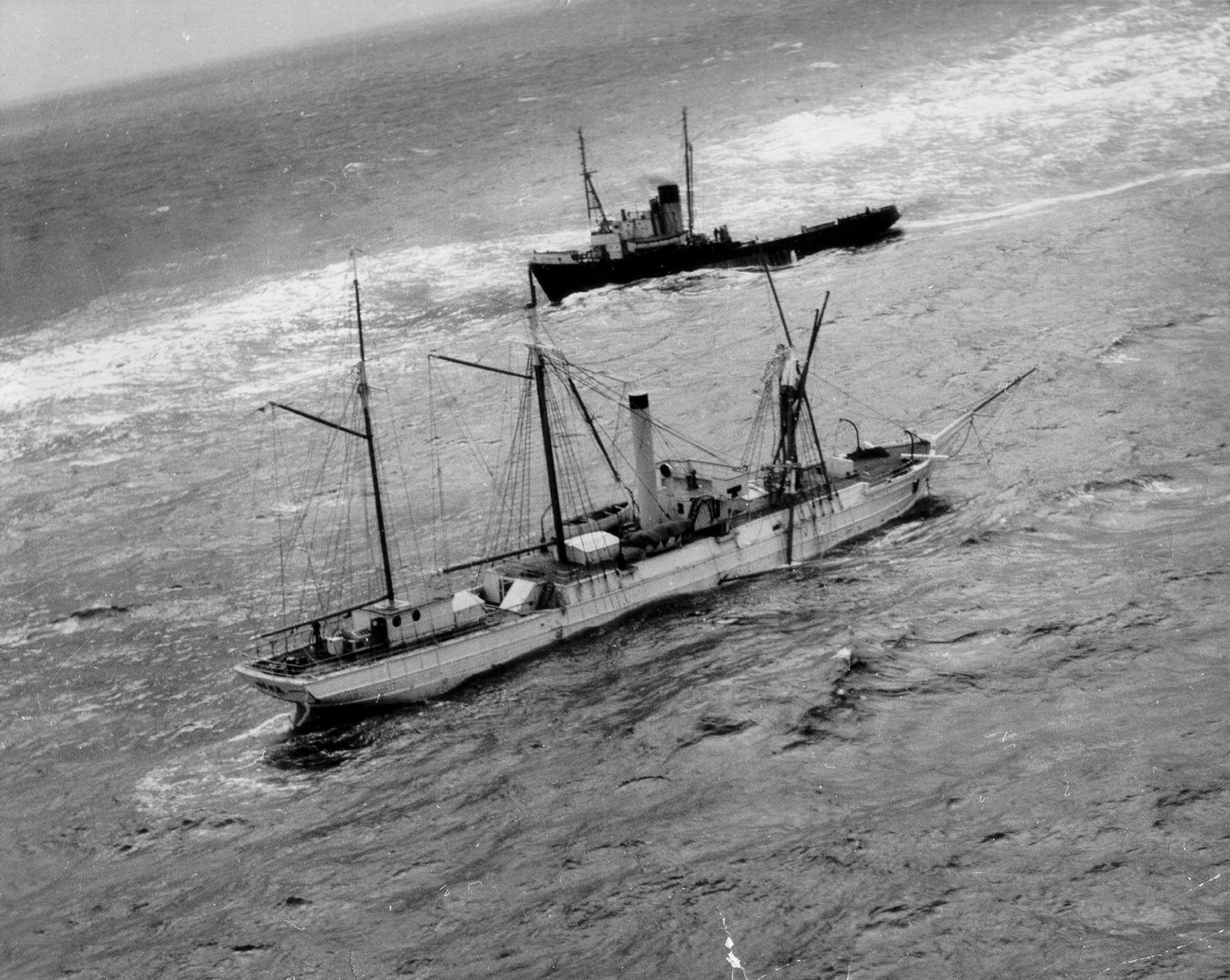
Johnston told the Chronicle-Herald by telephone that he was “pretty well upset”, that a big welcome had been planned in Philadelphia, and that there was no personal financial loss in the project itself. “The big loss came from the money we expected to make with the ship.” The trade paper noted that the tow had been “widely and bitterly attacked” in view of the weather.
The search, 1979 to 2021
In the spring of 1979 eleven cadets of the Coast Guard Academy, four advisers and Harold Edgerton of MIT, who had invented side-scan sonar, spent two weeks looking for her from the buoy tender Conifer, working from the accounts of the Coast Guard pilots who had flown over her and of the tug’s skipper. It was the first practical use of side-scan sonar with the Coast Guard’s new Loran-C navigation, and it found nothing. The expedition did not record where it had searched, and its report had no analysis of the sonar records. In 2007 the Navy’s submersible NR-1 searched on her last mission before decommissioning, and the records of that search were lost.
From 14 to 28 September 2019 the Coast Guard cutter Bear, a 270-foot medium-endurance cutter named for her, carried a team from NOAA Ocean Exploration and the Maritime Heritage Program of NOAA’s Office of National Marine Sanctuaries, under the archaeologist Joe Hoyt, over the ground with side-scan sonar. They mapped sixty-two square miles of seabed and found two targets. One was a wooden wreck about 260 miles east of Boston and 90 miles due south of Cape Sable, some twenty-four miles from the position the Irving Birch had radioed in 1963.
In June 2021 the Coast Guard buoy tender Sycamore took the team back with a remotely operated vehicle run by Marine Imaging Technologies, and in about 200 feet of water, in conditions that made it hard to hold position, it recorded some thirty hours of video. In August a team of historians and archaeologists from NOAA and the Coast Guard sat down with the footage, the 1874 builder’s plans from Mystic Seaport, a set of 1897 plans from the Coast Guard and the Smithsonian, and the photographs.
What they found is in their report. The wreck measured about thirteen feet shorter than the Bear’s 190 feet 4 inches at the waterline and fifteen feet wider than her 29 feet 9 inches of beam, which they put down to fishing gear dragging the stern away and the tanks out of the hull. The bow was the most intact part: five iron staples across the stem, thinner and closer together at the top and wider below, in the arrangement of a Coast Guard photograph; the half-round stem band; steel sheathing in the pattern of a drydock photograph of 1925; several layers of planking about seven inches wide. Where the engine room should be there was an empty compartment, and aft of it what looked like sections of shaft, and no engine, which was what the log of 8 May 1944 said. There was no ballast, which was what the Halifax owners had sold. There was nothing with a name on it. A few metres beyond the stern lay a cast-metal propeller post with the stern tube in it, and on it rows of bolt heads. Set beside the East Boston photograph of September 1933, the workmen and their propeller, the bolts matched. The team found the wreck to be the Bear “with a reasonable degree of certainty”.
On 14 October 2021, at the Black Falcon Terminal in Boston, Rear Admiral Nancy Hann of the NOAA Corps announced it for NOAA and the Coast Guard. “Today I’m pleased to announce that, with a reasonable degree of certainty, we have found the final resting place of the historic Revenue Cutter Bear.” Alongside the pier was the icebreaker Healy, named for the captain who had carried the first sixteen reindeer in her, just in from the Northwest Passage. The wreck lies in Canadian waters. Whatever is to be done about preserving it, NOAA’s expedition coordinator Brad Barr said, “will be another story yet to be written”.
The ship the entry is about is now a bow, a wheel, six bollards, some tanks and a propeller post, ninety miles south of Cape Sable, known by her bolts. Everything that could be taken out of her had been taken out before she went down: the engine in Boston, the ballast in Halifax, the masts in the gale. What was left was the part built in Dundee to meet the ice, and it was the ice-bow that was recognised.
Sources
- Dictionary of American Naval Fighting Ships, “Bear,” Naval History and Heritage Command. The thirty-four voyages, the 1929 sale to Oakland, the commissioning of 11 September 1939, the dates of the two Antarctic voyages, the return to Boston on 15 November 1943, the decommissioning of 17 May 1944 and the transfer of 13 February 1948. history.navy.mil
- Dictionary of American Naval Fighting Ships, “Northland,” for the Northeast Greenland Patrol and the Buskø on 12 September 1941. history.navy.mil
- US Coast Guard Historian’s Office, “Bear, 1885,” for the Coast Guard years and the decommissioning of 3 May 1929. history.uscg.mil
- William H. Thiesen, Coast Guard Atlantic Area Historian, background essays for the NOAA Bear expeditions, 2019 and 2021: “Bear and the Byrd Expeditions to Antarctica,” “Bear in World War II and Final Years” and “Search for the Bear, 1979–2019.” Coolidge and Oakland, the steam engine kept through 1935 and the diesel of 1939, the Greenland Patrol, the 1979 and 2007 searches. Byrd, final years, the search
- NOAA Ocean Exploration, “Search for the U.S. Revenue Cutter Bear,” expedition page, September 2019, and Brad Barr, “Search for U.S. Revenue Cutter Bear: Have We Found It?”, 11 October 2021. The 2019 and 2021 surveys, the evaluation team, the log entries of 9 October 1939, 25 November 1939 and 8 May 1944, the bow staples, sheathing and planking, the propeller post and the 1933 photograph, the dimensions and the position. 2019, 2021
- NOAA, “Wreck of famed Revenue Cutter Bear found,” news release, 14 October 2021. The sixty-two square miles, the two targets and the Sycamore. noaa.gov
- “End of the ‘Bear’,” Shipbuilding and Shipping Record, June 1963. The tow from Halifax, Chisholm, Coffin and Dingle, the dinghy, the riding light, the hour of sinking, Johnston’s insurance and his telephone interview. navalmarinearchive.com
- “Coast Guard announces discovery of lost US Revenue Cutter Bear,” Boston Globe, 15 October 2021. Hann’s and Hoyt’s words, the Black Falcon Terminal, the June dive and the thirty hours of video. bostonglobe.com
- Edward Lundquist, “Wreck of Storied Revenue Cutter Found,” Seapower, 15 October 2021. The Healy alongside, and Barr on Canadian waters. seapowermagazine.org
- Kaleb Cashen, “Which Byrd expedition member hitch-hiked across America for a job interview?”, History Corner, Byrd Polar and Climate Research Center, Ohio State University. Everything here on Joseph Hill Jr. The photographs on that page are Ohio State’s and from the 1937 book, and are not reproduced here. byrd.osu.edu
- Richard E. Byrd, Alone, 1938, for Advance Base and the winter of 1934.
- Wikipedia, “USS Bear” and “SS Buskø.” The 1948 sale to Frank M. Shaw and the 1962 sale to Alfred Johnston, the latter citing William Bixby, Track of the Bear, 1965; the museum plans of 1962 and the Mahone Bay repairs; the Buskø’s company, her arrival in Boston on 14 October 1941, and the standing of the “first capture” claim. USS Bear, SS Buskø